Your 2025 Tech Briefing: What to Act On, Ignore, or Keep Watching
Before you begin, a note.
This isn’t a listicle. It’s not a trend summary. It’s something else.
What follows is a real-world briefing retold as a narrative, in the room, as it happened.
A conversation sparked by the World Economic Forum’s 2025 Emerging Technologies list and turned into something deeper.
You’ll hear real voices. Maybe your own.
You’ll watch people shift, pause, reconsider.
You’ll move through each of the 10 technologies not as headlines but as prompts, provocations, and future-shaping questions.
This is how I work with clients. Quietly, clearly, conversationally. Helping teams explore what’s emerging, and decide what to act on, track, or move past.
It’s a long read. I’ve kept it whole so it feels like being there.
Skim if you need to. Settle in if you can. Either way welcome to the room.
Let’s begin.
__
Your 2025 Tech Briefing: What to Act On, Ignore, or Keep Watching
“Wait so this pill might treat Alzheimer’s and help you lose weight?”
She said it half-serious, half-suspicious. Across the table, someone else had already pulled up the article.
“Yeah. GLP-1s. Number six.”
The list had just dropped. The World Economic Forum’s Top 10 Emerging Technologies of 2025.
We weren’t there to dissect it. We were there to think ahead to open something up.
I’d brought the list into the session as a way to shift gears. Not to teach, just to spark.
We’d been sitting in the usual mix of market pressures and quarterly roadmaps.
But sometimes, the right list in the right moment gives people permission to imagine a little bigger.
And it worked.
One item turned into a conversation. Then two.
Soon we weren’t just reacting to the list we were using it to ask better questions.
Not just what’s coming, but how do we want to meet it?
That’s always the goal: to turn external noise into something internal and useful.
To help a team look outward, then turn the mirror back on themselves.
And if you’re reading this, you’re invited into that process too.
What follows isn’t a review. It’s a real-time replay
How we worked through the list, one by one.
Where we placed each item on the radar: Act, Track, or Move On.
And what ripple effects came up along the way across industries, across futures, across fears.
You’ll hear some voices.
You might even recognise your own.
Let’s start.
Part Two: The List Hits the Table
GLP-1s were where it started.
Number six on the list. A class of drugs already known for diabetes and weight loss, now showing early signs of helping slow Alzheimer’s and Parkinson’s.
One of the execs leaned back in her chair.
“So this isn’t future tech. It’s now, right?”
I nodded.
“It’s already here. What’s shifting is where we aim it. And who gets to decide what ‘health’ even means, long term.”
There was silence. The good kind.
Then:
“OK, so where would you put that on the radar?”
I drew a quick three-ring model on the whiteboard. Nothing fancy.
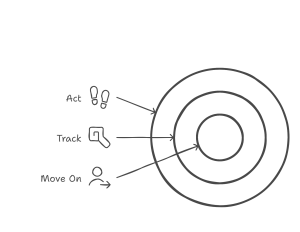
Act. Track. Move On.
It’s the same framework I use in advisory sessions a way to quiet the noise, place the signal, and understand what kind of future it’s pointing toward.
GLP-1s went straight into the Act zone.
Not because everyone needed to adopt them, but because everyone needed to start planning for the world they’d help reshape.
I saw it land.
Because this wasn’t just a health story. It was about aged care, workforce participation, retirement planning, longevity, insurance, memory, capacity, purpose.
“This one’s going to change who shows up to work, how long they stay, and what support they’ll expect along the way,” I said.
And quietly, beneath the surface, PTFA stirred.
You could feel it in the body language the memory of past health system strains, of aged parents lost in fog, of lives prolonged without quality.
“We’re not just living longer,” I said, “we’re living differently. And that’s what makes this signal strategic not medical.”
No one moved to the next item just yet.
That’s how I knew the future had started working.
One of the ops leads gestured at number three on the list.
“So this one… vehicles talking to each other? Feels kind of sci-fi. Or like something Tesla’s already doing?”
I walked over to the board.
“You’re not wrong. But the real shift isn’t the tech. It’s who gets to know and when.”
We were about to open up the whole question of invisible infrastructure, trust-by-default systems, and how collaborative sensing could quietly rewrite logistics, mobility, emergency response, and even liability models.
But I’ll save that for Part Three.
Part Three: Collaborative Sensing
“So this one… vehicles talking to each other? Feels kind of sci-fi. Or like something Tesla’s already doing?”
That came from someone on the ops side.
He said it with a raised eyebrow not dismissive, just cautious. A classic early radar read.
“It is happening,” I said. “But the signal isn’t the cars. It’s the conversation.”
“Between systems?”
“Between systems, yes but also between services. Cities, roads, weather data, emergency responders, infrastructure providers, insurers.”
There was a beat.
“We’ve spent a decade digitising what we can see,” I continued.
“Collaborative sensing is about what happens between what we can see in real time.”
Someone on the risk side leaned forward.
“So whose responsibility is that?”
And there it was.
The real question the one that surfaces in every industry eventually:
Who’s accountable when the decision is made by something ambient, something distributed?
“That’s why it sits in the Track zone for now,” I said, sketching it just outside the action ring.
“It’s not about rushing in. It’s about asking better questions before we get pulled into someone else’s model.”
They nodded. Not all at once.
But it was landing.
“If you’re in logistics, insurance, transport, or urban design, this is going to touch your workflows. Not in five years. In two.”
A head of digital who’d been quiet until now spoke up.
“So we don’t need to build it, but we do need to plan around it?”
“Exactly. That’s the play. It’s about preparing the ecosystem not just the tech stack.”
Then came the best question of the session so far:
“What don’t we see yet because we’re not listening for it?”
That’s future-sense-making.
When you stop asking what the tech can do, and start asking what it makes possible or invisible.
Collaborative sensing doesn’t just change what we know.
It changes who knows first.
And in a system, that’s power.
We were three signals in when someone scanned the list again and paused at number five.
“Green Nitrogen. That one… feels like a chemistry set. Does it matter to us?”
I smiled.
Because that’s often where the big shifts hide not in the shiny, but in the quietly essential.
Part Four: Green Nitrogen
“Green Nitrogen. That one… feels like a chemistry set. Does it matter to us?”
It always starts like that.
Something sounds small, scientific, or too far from the core business to take seriously.
But that’s exactly where future shifts like to hide wrapped in process, hidden in plain supply chains.
I walked to the board, circling it gently.
“Fertilisers,” I said. “Ammonia production, to be exact. One of the most energy-hungry industrial processes on the planet.”
The CFO looked up.
“And someone’s found a greener way?”
“A cleaner way,” I said. “Instead of using fossil fuels, you use electricity. If that electricity’s renewable, you’ve just stripped out a major carbon load from global food production.”
There was a pause.
Then the strategy lead asked it.
“Why haven’t we heard more about this?”
“Because it doesn’t have a launch video,” I said, half smiling. “No celebrity endorsement. But it does reshape the ESG investment map. It changes how sovereign nations negotiate food security. It creates a new category of competitive advantage, ethical supply by design.”
The room softened.
You could feel the shift the appreciation for something that didn’t sparkle but sounded important.
“It sits in the Act zone,” I added, marking it clearly.
“Especially for anyone connected to agriculture, logistics, impact investment, or carbon-led transformation work.”
One of the team scribbled something in the margin of her notebook. Another tapped on a device probably flagging it for follow-up.
That’s the kind of signal this is:
It doesn’t provoke. It grows.
And the ripple effects are long and structural.
“The last time fertiliser tech shifted,” I said quietly, “it was called the Green Revolution.”
No one joked after that.
Not out of fear. But out of realisation.
Up Next: Structural Battery Composites
One of the engineers looked up.
“Can I pick the next one?”
“Sure.”
“Structural batteries. I’ve been waiting for this.”
And just like that, the room lit up again.
Part Five: Structural Battery Composites
“So this one’s mine,” the engineer said, tapping the screen. “Structural batteries. Feels space-age already.”
I smiled.
“It’s not just the future of EVs,” I said. “It’s the future of form itself.”
The whiteboard marker was already in my hand.
I drew a quick sketch a car frame that was the battery.
A bike body that powered itself.
A drone whose wings carried the charge.
“If we stop building frames around batteries and instead build them into the structure itself, you free up weight, space, and design limits.”
The supply chain strategist leaned forward.
“So we’re not just talking lighter cars. We’re talking rethinking everything we make?”
“Exactly. Every product with a shell or frame becomes potential energy storage.”
That’s when it landed.
“This doesn’t just change transport,” someone whispered. “It changes manufacturing. Even architecture.”
The ripple effects started sketching themselves.
- Mobility devices that weigh half as much
- Furniture that charges phones
- Wearables that store their own power
- Buildings that draw and store energy in their very structure
“It’s also a materials play,” I said. “Whoever controls the next-gen composites will lead a whole new industrial base. Think beyond lithium. Think lighter, stronger, smarter.”
In HUMAND terms, this is classic middle-ground innovation
AI can optimise it.
Machines can assemble it.
But humans?
We’ll be the ones who decide what to build with it.
This is one of the few on the list that sits on the edge of Action and Monitor depending on your sector.
For automotive, aerospace, advanced manufacturing, and even consumer tech?
You should be prototyping or investing already.
“If I were briefing a consumer brand,” I added, “I’d be saying: don’t wait for it to be affordable. Start imagining what it lets you create differently.”
Someone in the room looked up.
“So this is design freedom.”
“It’s also supply chain pressure,” I said, nodding. “Because once someone else integrates it, your traditional offering starts looking heavy. Outdated.”
“Which is code for…”
“Don’t fall asleep on this one.”
Coming Next: Generative-AI for Scientific Discovery
“We’ve all been waiting for the AI one,” said someone from the legal team.
“But let’s not assume we know what it means.”
“Exactly,” I said. “This one’s not about chatbots.”
And with that we turned the page.
Part Six: Generative AI for Scientific Discovery
“Wait, this is the AI one?” someone said. “Haven’t we already seen what it can do?”
I paused.
“Not this flavour,” I replied.
“This isn’t the chat-GPT, viral-video, write-me-an-email AI. This is the one that helps us discover what we didn’t even know to ask.”
The room got quiet.
I sketched a spiral.
“Think of scientific knowledge as a spiral staircase. We’ve spent centuries walking up step by step. What generative AI can do now is jump three levels at a time not by guessing, but by modelling entire chemical universes, biological sequences, and physical possibilities.”
“So it’s not replacing scientists,” said one of the health execs.
“It’s accelerating them,” I nodded. “Imagine shortening a 10-year drug discovery to six months. Not just speeding it up — but opening entirely new fields.”
And that’s the ripple.
- In biotech? Faster, more targeted treatments.
- In materials science? Discovering compounds we never imagined.
- In climate research? Simulating future environments in minutes.
- In energy? Modelling quantum-level behaviours, not just human logic.
“And for those not in science?” someone asked.
“You’ll still feel it,” I said.
“Because everything you touch your food, clothes, medicine, packaging, transport is touched by science.”
This isn’t just about algorithms. It’s about epistemology how we know what we know.
And here’s where PTFA creeps in.
Because if your organisation is still holding onto the “We’ve always done it this way” comfort blanket
You’re not just at risk of falling behind.
You’re already out of step with the discovery curve.
In HUMAND terms, this sits firmly in the AI+Machine+Human zone where our creativity meets AI’s possibility engine.
“We still need humans to make the final call,” I added.
“But now we have something standing beside us saying, ‘What if?’ 10,000 times a second.”
So what does this mean for business?
If you’re in pharma, agriculture, materials, or even retail you need to stop looking at AI as a tool for marketing or automation.
Start seeing it as a partner in possibility.
Coming Up: Eco-Friendly Refrigerants
“Right,” said someone from the logistics team.
“Now we’re talking supply chains, warehouses, and compliance. This one’s going to get messy.”
“And expensive,” someone else muttered.
I nodded.
But not for the reasons they expected.
Part Seven: Eco-Friendly Refrigerants
“So… fridges?” someone offered, eyebrows raised.
“Yes,” I said, “and no.”
This wasn’t about the kitchen.
It was about every warehouse, every cold supply chain, every supermarket aisle, hospital lab, freight container, vaccine centre, datacentre, and server room. And soon every building under ESG scrutiny.
“Refrigerants have been one of the planet’s worst-kept secrets,” I told them.
“The old ones, HFCs, trap thousands of times more heat than CO₂.”
“So we banned CFCs, and now HFCs?” someone asked.
“Correct. But the replacements we rushed in aren’t much better. And global demand is exploding not shrinking.”
The WEF placing eco-friendly refrigerants on the 2025 emerging tech list signals this:
We’re about to undergo one of the most under-the-radar yet high-impact industrial shifts in the next five years.
“Think of this as the plumbing of the 21st century,” I said.
“Invisible, critical and suddenly being rewritten.”
The Ripple Effects
- Retailers & Cold Chain Logistics: Compliance pressure is about to ramp up. New materials, new audits, new procurement priorities.
- Real Estate & Facilities: Rethink HVAC systems. New refrigerants often require entirely new infrastructure.
- Health & Pharma: Blood, organs, vaccines your cold storage needs are entering regulatory spotlight.
- Data Centres: Cooling is 40%+ of energy usage. Future cooling tech = future competitiveness.
“But it’s just gas,” someone whispered.
“It’s never just gas,” I smiled.
“It’s systems. Supply chains. Liability. And the cost of inaction.”
And just like that, the boring topic became urgent.
From HUMAND’s View
In the HUMAND framework, this sits in the Machine zone it’s not creative or cognitive work, but it’s vital infrastructure.
Yet it affects human futures profoundly from climate impact to global health.
And in PTFA terms, this is where avoidance lives.
“We’ll upgrade later.”
“It’s not in this year’s budget.”
“We don’t use much cooling anyway.”
But the time for postponement is over. Not because it’s fashionable — but because the regulators, climate commitments, and next-gen technology are colliding.
“So, should we be worried?” they asked.
“No,” I said.
“You should be ready.”
“Now this one sounds like something from Star Trek,” someone chuckled.
“It’s even better,” I replied.
“It’s like bending reality without the CGI.”
Ready to dive in? Metasurfaces are next.
Part Eight: Metasurfaces
“Alright, now this sounds like Star Trek,” one of the younger execs said, finally grinning after thirty minutes of regulatory chat.
“You’re not wrong,” I told him.
“We’re talking about materials that can manipulate light, sound, even electromagnetic waves.”
Pause.
“You mean like… invisibility cloaks?”
“Among other things,” I smiled.
At its core, metasurfaces are ultra-thin materials designed to interact with energy in highly controlled ways. They’re engineered, not found meaning we can program how they behave.
This is a new class of smart matter. They don’t just sit there they do something.
What Can They Actually Do?
- Bend or absorb light — making lenses flatter, cameras smaller, and cloaking devices plausible.
- Redirect radar or sound — with military, security, and acoustics implications.
- Manipulate heat — offering passive thermal control without electricity.
- Boost signal performance — improving everything from mobile networks to satellite comms.
“This is magic stuff,” one person whispered.
“It’s physics,” I replied. “But it feels like magic.”
The Ripple Effects
- Telecoms & Connectivity: Metasurfaces could reshape how signals are sent and received think better 6G, satellite links, or Wi-Fi through walls.
- Healthcare & Imaging: Compact lenses = smaller, cheaper diagnostics.
- Defence & Aerospace: Stealth and tracking are being rewritten.
- Consumer Electronics: Cameras without lenses. Screens that self-adjust. Phones that signal better inside concrete towers.
Strategic Radar Placement
Right now, this one’s early-stage Signal, not yet System.
But it’s a classic case of exponential compounding. Quiet academic beginnings that suddenly rewrite everything at once. Like graphene. Or semiconductors.
“So, we invest now?”
“You listen now,” I told them.
“You build partnerships, you monitor breakthroughs, and you prepare to leap because once it hits your sector, it will move fast.”
And in that moment, I watched three different execs jot down the same word:
Watchlist.
From a HUMAND Angle
This is AI + Machine + Human potential in one.
Designing it requires human creativity. Deploying it demands machines. Controlling or applying it may involve AI for precision and performance.
It’s what I call a HUMAND edge case where no one actor (human, AI, or machine) wins alone.
Next up: Digital Therapeutics where apps go from calming your nerves to prescribing you a new brain.
“Wait, like a therapist in your pocket?”
“More like a clinician in your neural loop,” I said.
Part Nine: Digital Therapeutics
“You said this list would get more personal,” one of the team members said.
“This one feels… intimate.”
“It is,” I replied. “This one doesn’t just track your behaviour it reshapes it.”
Digital Therapeutics (DTx) aren’t just mindfulness apps or Fitbits.
They are clinically-validated software treatments, prescribed like drugs, but experienced as digital interactions.
Imagine an app that guides your breathing and calms your anxiety but one that’s been through clinical trials and TGA approval.
It’s not just wellness. It’s medicine.
What Are We Really Talking About?
- Apps that treat ADHD, chronic pain, addiction, depression, even diabetes.
- Algorithms that adjust in real time based on your neural or behavioural feedback.
- Platforms that work alongside or instead of pharmacological drugs.
- Data-rich insights feeding back to clinicians or AI systems for continuous recalibration.
It’s therapy without a therapist. Treatment without the pill bottle.
The Ripple Effects
- Pharma & Biotech: Drugmakers are either acquiring or partnering with DTx startups to stay relevant.
- Mental Health: Digital-first treatment could address clinician shortages and stigma barriers.
- Insurance & Reimbursement: Who pays? How is it regulated? The lines are still forming — and that’s the opportunity.
- Regulatory & Legal: What does “efficacy” look like in a UX interface?
“But can it work across generations?” someone asked.
“Some clients need therapy they trust. Others want it on-demand at 2am,” I answered.
“This meets them both or learns how to.”
From a HUMAND Perspective
This is pure HUMAND.
The Human craves emotional support.
The Machine delivers access at scale.
The AI personalises and fine-tunes your care loop.
Together, it’s a new therapeutic triangle.
“And if we’re not building or regulating it, we’re being treated by it,” I added.
“That’s not a future. That’s a Tuesday in 2027.”
If I were briefing a health insurer, hospital network, or HR team, I’d say this is no longer fringe.
This is your new competitor, collaborator, or cornerstone.
And if I were whispering to you as a fly on the wall?
“You’re not here to replace your care team. You’re here to reimagine what care means.”
Part Ten: Sustainable Aviation Fuel (SAF)
“Okay, now we’re flying,” someone quipped.
“We are,” I replied. “But the question is for how long, and at what cost?”
Let’s be clear: this isn’t a new idea. Aviation fuel made from waste, plants, or renewable energy sources has been on tarmacs and test flights for years.
But 2025? That’s when we start moving from experimental to expected.
And it’s not just planes. It’s supply chains, carbon offsets, tourism models, and entire economies that are due for take-off or turbulence.
What Is SAF, Really?
- A drop-in alternative to conventional jet fuel, made from sources like used cooking oil, municipal waste, and even captured CO2.
- Can cut lifecycle emissions by up to 80%.
- Compatible with existing aircraft no need to redesign the fleet.
- Backed by heavy hitters from Boeing and Airbus to governments with 2050 net-zero mandates.
But production is tiny. Costs are high.
And the climate clock is ticking.
“So is this greenwashing or game-changing?” someone asked.
“That,” I said, “depends on whether we scale it… or just talk about scaling it.”
The Ripple Effects
- Airlines must rethink not just what powers flights, but how they price, route, and report emissions.
- Governments will subsidise some players and penalise others.
- Corporate travel faces new scrutiny with ESG reports asking why you’re flying, not just how.
- Tourism boards will need new narratives, not just glossy brochures.
And passengers? They’ll soon be choosing between airlines not just by price or comfort, but by carbon literacy.
“Sustainable aviation,” I reminded the group, “isn’t just about the fuel.
It’s about whether this generation gets to keep taking off without leaving the next one behind.”
For Strategy, Risk, and Boards…
This isn’t a tech choice it’s a timeline decision.
Do you lead, follow, or get legislated into it?
If I were advising a logistics firm, airline, or travel industry board, I’d say:
“Don’t wait until SAF is mandatory.
Build the narrative, the partnerships, and the offsets now so you’re the first story in the sky, not the last apology on the ground.”
And just like that we’re back on the tarmac.
The WEF gave us ten signals. But really, they gave us a mirror.
A glimpse into the choices we’re about to make. The things we’ll fund, fear, follow, or forge ourselves.
The Wrap-Up: What These 10 Technologies Are Really Telling Us
“So… should we care?”
That’s how the client wrapped our session. Not dismissively, but thoughtfully a genuine ask.
Because that’s the real job of foresight, isn’t it?
Not to gawk at a list.
Not to guess which shiny thing will win.
But to read the room of tomorrow to map, measure, and make sense of which signals matter, when, and why.
What These 10 Tell Us Together
Individually, each of the WEF’s top ten has its own merit.
But taken as a whole?
They whisper something far bigger:
“The systems we’ve relied on to move, to feed, to treat, to think, to power are straining.
And the race is on to reimagine them before they break.”
That’s what I see.
That’s what my clients ask me to decode.
Not hype. Not headlines.
Horizon lines.
The Pattern Behind the List
Here’s what’s loud and clear:
- Energy is being rethought, whether it’s how we fuel jets or capture carbon mid-air.
- Biology and computing are merging, making therapies faster, smarter, and eerily bespoke.
- AI is no longer a tool; it’s becoming an embedded operating layer for everything.
- Manufacturing is shifting from mass production to micro, adaptive, sustainable creation.
- Climate resilience isn’t a separate stream it’s threading through all of it.
This isn’t a future of gadgets.
It’s a future of interdependence.
What to Do With It (A Strategic Radar for 2025)
You don’t need to understand every nuance. You do need to ask:
- What’s moving from lab to landscape in my industry?
- Where do I need fluency not mastery just enough to ask smarter questions?
- Which shifts invite reinvention? Where am I still patching the old?
Here’s how I’d suggest placing these on your radar:
| Tech | Urgency | Opportunity Zone |
| AI for scientific discovery | 🔴 High | R&D, IP, Pharmaceuticals, Academia |
| Privacy-enhancing technologies | 🟡 Medium | Data governance, Finance, Healthcare |
| Spatial omics | 🔵 Niche now | Diagnostics, Biotech, Personalised health |
| Flexible neuroelectronics | 🔵 Niche now | Medtech, Assistive tech, Wearables |
| Sustainable aviation fuel (SAF) | 🔴 High | Travel, Logistics, Policy, Carbon markets |
| Regenerative medicine | 🟡 Medium | Health, Insurance, Longevity economics |
| AI system optimisation | 🔴 High | Energy, Infrastructure, Industry 4.0 |
| Hydrogen planes | 🔵 Watchlist | Aerospace, National energy strategies |
| GenAI for biotech | 🔴 High | Pharma, Synthetic biology, AgTech |
| Direct air capture | 🟡 Medium | Carbon credits, ESG, Urban planning |
🔴 = Engage Now | 🟡 = Explore | 🔵 = Observe
This is how we prepare not predict.
So, Should You Care?
Only if you want to lead.
Only if you believe future-sense-making is part of your job now not a nice-to-have tucked under innovation or risk.
And if this list raised more questions than answers?
Good.
That’s exactly what it’s supposed to do.
A Quiet Offer, Just Between Us
This is the kind of work I do with clients every day behind the scenes, in boardrooms, on workshop whiteboards, in mid-air Teams and Zooms, in written regular written and recorded reports and on stage in keynotes and briefings.
Making sense of the future.
Mapping what matters.
Turning lists into lenses, and foresight into advantage.
If you want your own radar, not someone else’s, let’s build it together.
Until then: stay curious, stay kind, and keep looking just a little further than the edge of today.
Choose Forward.
____
Was there one technology that surprised you?
One that felt closer than expected?
Leave a comment or send me a note I’m always curious what lands where.
___
About the author
Morris Misel is a human-first futurist, advisor, presenter and strategist helping leaders make sense of what’s next.
Heard by millions each year onstage and in media, he works with organisations across 160+ industries to decode emerging signals, uncover ripple effects, and build futures worth inhabiting.
This blog is part of his ongoing mission to turn lists into lenses and conversation into clarity.
___
#MorrisMisel #2025TechBriefing #EmergingTech #ForesightStrategy #FutureSenseMaking #StrategicRadar #RippleEffects #LeadershipForesight #WEF2025 #KeynoteSpeaker #FutureOfWork #ExecutiveStrategy #InnovationLeadership #HUMAND #PTFA #DigitalTherapeutics #GenerativeAI #SustainableFutures