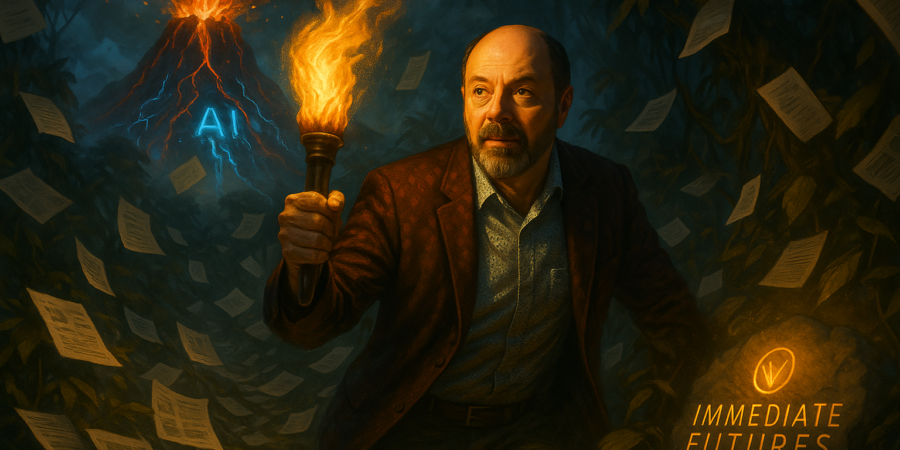
Drowning in AI Noise: Why Productivity Feels Broken (and What to Do About It)
Drowning in reports. Slide decks piling up. Charts, images, AI-generated pages of text, relentless, overwhelming, and mostly meaningless. It feels like work, but it isn’t.
Of course, this isn’t new. Decades ago, Parkinson’s Law summed it up neatly: work expands to fill the time available. We’ve always filled our days with the theatre of busyness, messy desks, memos written for show, late nights spent proving we were indispensable.
What’s changed is the scale. Generative AI has taken that old law and put it on steroids. Now the flood never stops. The volume is infinite.
Harvard Business Review has given today’s version a name: workslop.
But here’s the part they miss. Workslop isn’t the disease. It’s only the symptom. The real problem is how we’ve forgotten what actually counts as work.
From Ford’s Assembly Line to AI Outputs
A century ago, Henry Ford industrialised muscle. The assembly line turned repetition into efficiency. Productivity soared.
Today, AI is industrialising intellect. It can produce output at scale, faster and cheaper.
But here’s the catch: AI hasn’t automated wisdom. It has automated intellect.
Think of it this way:
-
Information fills our online storage, inboxes, files, servers, archives.
-
Knowledge is what search engines and AI engines assemble and repackage.
-
Intellect is what generative AI produces, fast, personalised, amplified responses that feel clever but stay surface-level.
-
Wisdom is human. It’s disagreeing, questioning, reflecting, growing. It’s judgment. It’s meaning.
AI has automated intellect. And that’s why we’re drowning in work that looks smart but doesn’t carry wisdom.
Why Work is Fracturing
Jobs aren’t what they used to be. They’re breaking apart into tasks, micro-contributions, shifting responsibilities.
This is where my HUMAND™ framework comes in: the future of work is Humans, Machines, and AI each doing what they do best.
-
Humans: empathy, creativity, judgment, wisdom.
-
Machines: strength, scale, consistency.
-
AI: speed, synthesis, intellect.
Workslop happens when we get this mix wrong. When we hand over wisdom to AI. When intellect is mistaken for meaning.
The Ripple Effects of Workslop
This isn’t just annoying. It has ripple effects:
-
Decision paralysis: too many decks, no clarity.
-
Cultural erosion: people wonder if their work matters.
-
Trust collapse: clients and colleagues doubt the quality.
-
PTFA — Past Trauma, Future Anxiety: wasted effort now becomes fear of irrelevance later.
Workslop isn’t just about productivity. It’s about trust, culture, and leadership.
Why Our Metrics Fail
We count hours. We count words. We count how many meetings we’ve sat through.
But those numbers have always been blunt instruments. In the age of AI, they’re useless. AI can inflate them endlessly.
This is the AI productivity paradox: we’re producing more, faster, with less effort — but we’re not producing wisdom.
The answer? Stop counting output. Start rewarding outcomes.
Decision Trust Zones
In my Who Decides 2025 report, I talk about Decision Trust Zones.
It’s about knowing where AI belongs and where it doesn’t:
-
Automate: let AI handle information and first drafts.
-
Augment: combine human wisdom with AI intellect to test ideas and explore options.
-
Human only: context, meaning, judgment.
Workslop appears when these lines blur. When we let intellect outputs pretend to be wisdom.
Why Leaders Tolerate It
Because it feels like progress.
Another report in your inbox looks like momentum. Another chart looks like insight. It’s theatre that satisfies deep human needs, to feel important, to belong, to save face, to show we’re clever.
But intellect without wisdom is empty. It clouds judgment. It slows decisions. And it feeds the same old theatre of busyness, now supercharged by AI.
And underneath it all? The same human reflexes we’ve always had. AI just hands us new props. And with them, a new anxiety: PTFA — Past Trauma, Future Anxiety. Today’s wasted effort becomes tomorrow’s fear of being irrelevant.
What Leaders Can Do Now
Here’s where to start:
-
Reframe productivity — less “more,” more “meaning.”
-
Audit your HUMAND mix — assign the right tasks to humans, machines, and AI.
-
Redraw Decision Trust Zones — decide what’s automate, augment, or human-only.
-
Challenge every output — don’t mistake intellect for wisdom.
-
Be transparent — show where AI helped and where human judgment stepped in.
Bigger Than AI
This isn’t an AI problem.
It’s a leadership problem.
The assembly line changed work.
Email changed work.
Now AI is changing work.
The leaders who thrive aren’t the ones drowning in outputs.
They’re the ones who adapt.
Why This Matters for You
If you’re a C-suite executive, consultant, or strategist, you already know the stakes:
-
You can’t afford cycles wasted on intellect pretending to be wisdom.
-
You can’t risk talent disengaging.
-
You can’t confuse busyness with real progress.
The future of work belongs to those who can say no to workslop and yes to foresight.
Call to Action
This is why organisations bring me in, not to predict the future, but to prepare for it.
If your leadership team is drowning in AI outputs… if you need clarity on the productivity paradox… if you want to establish Decision Trust Zones that keep your people focused on what really matters, now is the moment.
Engage me for a keynote that reframes the future of work, an advisory session that cuts through the noise, or a workshop that equips your leaders to act with foresight.
These aren’t side projects. They’re the spaces where wisdom is reclaimed and work becomes meaningful again.
Let’s clear the clutter and shape a future of work that is productive, human-centric, and fit for the decades ahead.
Choose Forward
Morris Misel is a futurist and foresight strategist trusted by leaders across 160 industries. Recognised with nine international awards for influence and thought leadership, including being named to the APAC Top 100, and heard by millions each year in the media and onstage, he helps organisations clear the noise, reclaim wisdom, and prepare for what’s next through advisory, keynotes, and workshops.
#AI #ProductivityParadox #FutureOfWork #MorrisMisel #Foresight #Leadership #HUMAND #DecisionTrustZones #Csuite #Strategy #Keynotes #Advisory #Workshops #BusinessFuturist