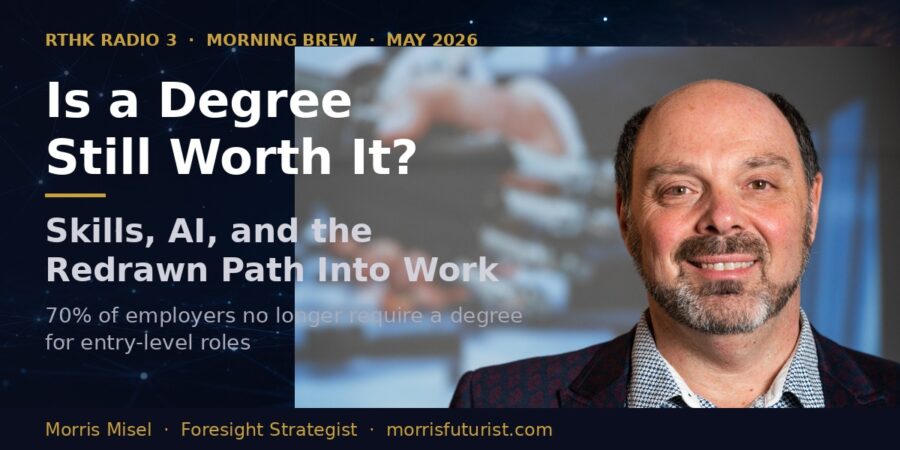
The Degree Question: Why the Path Into Work Is Being Redrawn
The contract broke quietly. Employers rewrote it. Nobody told the students.
For most of the past fifty years, the arrangement was understood: stay in school, perform well, earn your place at university, graduate, and the credential would open the door. The degree was the signal. It told an employer you could commit to something, sustain effort over time, and produce work under pressure. Reliable enough to become the default. Not just useful. Assumed.
That assumption is failing now. Not with an announcement. Not with a policy change anyone can point to. Quietly. In hiring decisions that stopped requiring the thing they always required. In job ads where a line simply disappeared. In graduate intakes that got smaller, then smaller again. In accounting firms and law firms and engineering consultancies that used to hire fifty graduates a year now hiring twelve.
You can listen to the full segment with Phil Whelan on RTHK Radio 3 Morning Brew below:
Phil and I had spent the previous week on polyworking, the shift toward people holding multiple roles simultaneously. The credential question follows directly from that one. If people are already rethinking how they combine and sequence work, it is worth asking whether the credential that was meant to gate the entry point still makes sense.
This is the question Phil Whelan and I arrived at on RTHK Radio 3 Morning Brew this week: what is the credential actually for? Because the employers have already answered that question. Their answer is different from the one they gave five years ago. And most of the people the answer affects have not yet been told.
We Are Going Back to the Artisan
Here is what I think is actually happening underneath all of this. We are returning to something old. Not the industrial model that universities were built to serve, but something that preceded it by several centuries: the guild.
In the 1400s, 1500s, 1600s, if you wanted to work in a trade you went to a guild. You found the people who controlled that domain of craft. Mason, joiner, plumber, blacksmith. You apprenticed under someone who had done it longer, you learned by doing it poorly and then less poorly, and you graduated when the work was genuinely good enough. You were called an artisan. You carried that identity for life.
The industrial revolution displaced that. It needed generalists. People who could do many things adequately, show up, follow a process, answer a phone, type a letter, file a report. Universities were built to produce exactly that person. And for most of the last two hundred years, they did.
Now AI is doing the peripheral stuff. The routine, repeatable, process-following work that made generalism necessary is being absorbed. What is left is the core. What do we actually do? Not all the surrounding work that we had to do because it had to be done by someone. And that pull, slow and uneven as it is, is taking us back toward the artisan model. Toward demonstrated capability over certified attendance.
I explored the mechanics of this shift more directly in AI Isn’t Taking All the Jobs. It’s Rewriting the Task List. The first move AI makes is rarely the whole job. It is the task list, the routine, the repeatable, the peripheral. And once the task list changes, the shape of the role changes with it.
The Signal: The Credential Is No Longer the Signal
Here is what the data shows, and the specifics matter.
The National Association of Colleges and Employers 2026 data puts 70% of employers now using skills-based hiring for entry-level roles. That number alone is striking. But the sharper finding is the GPA collapse. In 2019, 73% of employers used grade point average as a screening criterion. Today that figure is 42%. That is not a gradual drift. That is a structural withdrawal from the credential as a proxy for capability. In seven years, nearly half of those employers stopped caring about the metric that universities spend four years generating.
Coursera’s data from the same period: 90% of employers say they prefer a candidate with a micro-credential on their CV over one without it. Not a degree. A specific, demonstrated competency. The Western Governors University Workforce Decoded Report, which surveyed 3,147 US employers in late 2025, found 46% plan to increase their focus on skills over degrees in 2026. And 38% are already reducing entry-level hiring because AI is doing the work those entry-level hires would have done.
Greg Hart, CEO of Coursera, put the underlying logic directly: “As people recognize that AI is enabling technology to do more and more of people’s jobs, the value of the human side of the equation actually increases.” What he means is that the residual value is not in what you know in the abstract. It is in what you can do with what you know, in context, with judgment, under conditions that do not match the textbook. That is much harder to screen for with a transcript.
This is the Immediate Future that most universities have not yet reckoned with. Not because the people inside them are unaware. Many of them know exactly what is happening. But the institution moves slowly, and the employment market does not wait.
The generation walking into this right now is the first to face it in its fully formed state. Gen Z unemployment in the United States sits at 14% for 16- to 19-year-olds, 9% for 20- to 24-year-olds, against an overall rate of 4%. That gap is not explained by attitude or effort or entitlement. It is structural. The entry points they were told to expect are no longer there in the form they were described.
We spent fifty years telling young people the degree was the path. The people doing the hiring have quietly changed the path without telling anyone.
The Ripple Effects: Where the Ground Is Shifting
The consequences run further than any individual hiring decision. Let me trace a few of them.
The first ripple is the collapse of the entry-level pyramid. The large professional services firms, the accounting firms, the law firms, the engineering consultancies, all operated on the same model. Large graduate intakes at the base. Those graduates did the grunt work: the research compilation, the first drafts, the due diligence checklists, the data gathering. They were not well paid, but the deal was clear. You put in your time at the bottom, you learned, and over five or eight years you moved up. The firm got cheap labour. The graduate got formation.
AI is doing most of that work now. The pyramid is not just shrinking. It is structurally broken. The base has been removed. And the path that millions of people expected to walk into a profession does not exist in the same form. The broader structural argument, why work itself is being redesigned even as job titles appear stable, is something I laid out in The Workforce Revolution: Why Jobs Are Over But Work Is Not.
The second ripple is the disappearance of the internship. The internship was the workaround. If you could not land a graduate role, you got an internship. Low pay, long hours, but a foot in the door and a line on the CV. Firms that used to take twenty interns now take four, or none. The work those interns would have done is now done by a language model. It is not only going to be a thing of the past. In many professional contexts it already is.
What matters here is not just that fewer young people are getting experience. It is that the mechanism by which people learned professional culture, developed judgment, and built early relationships inside industries is being removed. That gap will not fill itself. The organisations that think deliberately about how people now build capability early in their careers will be well ahead of those waiting for the old pipeline to refill itself on its own terms.
The third ripple is a generational trust problem. Young people who were told throughout school that a degree was the reliable path are now arriving at the workforce to find the path has moved. The cost has not moved. The debt has not moved. But the return is less certain. That is a significant breach of a social contract that has underpinned education policy for fifty years, and we have not had an honest public conversation about it yet.
The Human Lens: What This Feels Like From Inside
This is not only a policy or strategy question. It is deeply personal.
I spent twenty years lecturing. I have written curricula. I love higher education as an institution and I believe in what it does at its best. But I need to be honest about what its current form produces for a significant portion of the people walking through its doors.
When students arrive at eighteen because it was the obvious next step, because their parents expected it, because their results pointed that way, because there was nothing else that seemed available, they often struggle. Not always with the academic work. With the question of whether they should be there at all. And then about ten years later, there is a reckoning. A quiet accounting of what the degree cost, what it produced, and whether the exchange was fair.
The mature-aged students were always different. Not smarter. More present. Their reason for being there was specific. The work made sense to them because they already understood what they were doing it for. That difference in orientation made an enormous difference to what they got out of the experience.
The gap year has become genuinely normal in Australia for exactly this reason. Not to delay the question, but to arrive at it with some experience behind you. Some sense of what you actually want before you commit to a path that costs real money and takes real years. I think it is one of the most sensible things a young person can do, provided they are intentional about it. Not bumping around, but trying something, working somewhere, finding out what they are actually good at and what they are actually drawn toward.
The Apprenticeship Reassessment
There is still a class snobbery around apprenticeships in parts of Australia. Not everywhere, and not universally. But it persists. The idea that vocational training is for other people’s children.
The irony is that the tradespeople, the plumbers, the electricians, the builders, often come out of training with lower debt, a paying role from day one, and income trajectories that overtake their degree-holding peers within a decade. The person who spent four years at university is often still paying back fees at the point where the tradesperson is running their own business.
That economic reality is not new. But it becomes harder to argue around when the white-collar pyramid is breaking down. If the rationale for a degree was a reliable entry into a stable career trajectory, and that trajectory is now less stable and less guaranteed, the calculus changes.
This is not an argument against university. It is an argument for being honest about what it is for, and what it is not for, and for whom it is the right path and at what point in a life.
The “show me” economy is what some researchers are calling this: portfolio over transcript, demonstrated work over certified attendance. That orientation, output over input, is the right one for a world where what you can do matters more than what you were taught. It is just not yet the norm in Australia or the United States at an institutional level.
What Institutions Are and Are Not Doing
Universities are structurally rigid. They are governed by external bodies, by governments, by accreditation frameworks, by standards set not by the people who teach the courses but by people outside the institution. I wrote about this structural problem more directly in Majoring in Obsolescence: Why We Keep Graduating Students for a World That No Longer Exists, the rigidity runs deeper than most reform conversations allow for. The certificate at the end has requirements that are beyond the reach of any individual lecturer or department to change unilaterally.
The people inside universities are doing what they can. The good ones are adjusting their teaching, finding ways to bring practical experience into the course, building industry placements in, letting students get their hands on real work before they graduate. The course I ran required a work component in the final year. That was deliberate.
But that is adaptation within constraints. It is not structural reform. And the constraints are not moving fast enough to match the speed at which the employment market is moving.
Some places are doing this better. Countries like Denmark are looking at the output rather than the input. Asking whether the student can actually do the thing, rather than whether they completed the prescribed sequence of assessments. That is the right orientation. It is just not yet the norm.
Three Things I Recommend You Do
The first thing to do is audit your organisation’s entry requirements. If you are still filtering applications by degree, you are removing a significant portion of capable people who have built skills through other paths. Look at what the entry-level role in your organisation actually requires. Ask honestly whether a degree is a genuine indicator of that capability, or whether it has become a habit that has not been reviewed. In most cases, the filter is the habit. I wrote about the thinking error underneath this in The Hiring Crisis Is a Lie: Why You’re Not Short of People, You’re Short of Imagination, the problem is usually not the candidate pool, it is how the role itself has been defined.
The second thing to do is take the apprenticeship and skills pathway conversation seriously in your sector. If you are in professional services, technology, or any field that traditionally relied on graduate recruitment, ask what the new entry point actually looks like. Who are you bringing in, through what pathway, and what are you asking them to demonstrate? The old pipeline has changed. The organisations that deliberately design a new one will be well ahead of those waiting for the pyramid to refill itself on its own terms.
The third thing to do is talk to the young people in your life about this honestly. Whether you are a parent, a manager, a teacher, or a school leader, the most useful thing you can offer is a clear account of what has changed. Not reassurance that everything is fine. Not alarm that everything is broken. An honest account of the signals, the options, and the questions worth asking before committing to any particular path. Because the people who made the decision quietly are not going to do the explaining. That falls to us.
The Closing Thought
The degree question is not actually about degrees. It is about what we believe is worth spending years of your life on, what competence actually looks like, and what we owe the people who are just starting out.
The credential that was once a reliable signal has become an unreliable one. Not worthless. Not irrelevant. Unreliable. That is a different claim, and it is an important one. Because it means the question is not whether to go to university, but whether to go, to what, for what reason, and whether the alternative paths have been given an honest hearing.
The path into work is being redrawn. That is uncomfortable for institutions, for families, and for anyone who built their identity and their expectations around a particular arrangement. But it is also, if we are prepared to see it clearly, an opening. The slow return to the artisan model, to demonstrated capability, to the question of what you can actually do rather than what you were certified to know, puts something real back at the centre of the conversation.
Not prediction. Preparation.
If the questions in this post are landing close to home for your leadership team or board, this is exactly the territory I work in, reading the signals around work, skills, and workforce strategy before they become a crisis. Get in touch.
You can also subscribe to my Immediate Futures briefing, a short, weekly read on the signals worth paying attention to, written for leaders who want to stay ahead of what is already arriving.
About Morris Misel
Morris Misel is a foresight strategist, keynote speaker, and media commentator. He works with leaders, executives, boards, and associations worldwide, reading the signals, tracing the ripple effects, and sharpening the strategic choices that matter before uncertainty forces the decision. His work spans Asia-Pacific, North America, and Europe, across financial services, healthcare, government, professional services, and technology. He is a regular commentator on RTHK Radio 3 Morning Brew in Hong Kong.
Enquire about a keynote or workshop → · Subscribe to Immediate Futures →
Choose Forward.
#FutureOfWork #UniversityDebate #SkillsNotDegrees #AIAndWork #EducationFutures #Leadership #WorkforceStrategy #Apprenticeship #MorrisMisel #RTHK #MorningBrew #ChooseForward
Full Segment Transcript, RTHK Radio 3, The Brew, 19 May 2026 ▼ Click to expand
Morris Misel speaking with Phil Whelan on RTHK Radio 3 Morning Brew
**Program:** The Brew, RTHK Radio 3
**Segment:** Morris Miselowski, Biz futurist
**Episode ID:** 1102674
**Topic:** Are young people still prioritising university? Artisan economy, AI, and the 70% employer signal.
**Date:** Tuesday 19 May 2026
,
Good, good, good, good, good. That’s jungle, I’m ready. A three in good times for a pretty slimy Tuesday afternoon, but nowhere is a tool. Great to be with you, but stay in because the thunderstorm warning is out there until at least one o’clock in Hong Kong. However, in Melbourne, keep Morris. Did I have to choose to have run in Melbourne? There was blue skies. Had you of asked me an hour ago? Three hours ago was a beautiful sunshine. Yay, Melbourne. Brilliant. So, what we tend to do on Tuesday is he’s rambles with a few WhatsApp messages and stuff. Morris has been talking about different kinds of job recently, and we started ages ago with the gig type of job. And what was it last week, Poly? Polywork? Polywork? Polywork? So, I’ve had an idea that our people going back in time in a way when they left school and they made money, and they were apprentices, and they learned on the job. Our people still really excited about going to university. Of course, there’s a lot of research, a lot of comment about this. But let’s start with you. What do you reckon? Yes. Yes, basically they are. Yes. Because we’re talking about this for a while. I absolutely set it for decades now. We’re going back strangely enough to what I think of the old artisan days. That’s what I’m on about. Yeah, yeah, absolutely. The old artisan days. Now there’s an instrument that you had a craft. You know, there was a skill you went to a guild. If we go back into the 14, 15, 16, 1700s. In other words, you went to a group of people that kind of controlled that particular element of work. It was a plumber of, you know, a whole strong car. Whatever it was, Mason. Mason, all the rest of them. Absolutely. They were all guilds. I mean, guilds were really preceded unions. And you went there to learn your trade and you were called an artisan when you finished and you had a very specialist trade given to you through your hand. And you were good at it by all accounts. Well, you’d spent so long literally doing it physically. under the children, which of somebody who had done it even longer, that the only way you could graduate was to do good, otherwise you would just throw it out, and you were called an artist and you were pretty much that for life. I think we’re moving back to artists, and I think we’re moving back for a number of reasons, but firstly, most of us through this industrial revolution period in our last couple of 100 years, we had to become generalists. We had to do lots of stuff in order to get what we actually wanted done done. So whatever it is we had to do, you know, we had to learn to type as well, we had to learn to answer a phone, we had to learn to do all kinds of things, around really what we did. Today, more than ever, you know, T.C. is kind of stopped some of that, internet stopped some of that, because things became done by other things, but now with AI, a lot of the routine stuff being stripped away. I ate his hands now, aren’t we? Well, yeah, that’s actually not bad, absolutely. It’s almost a tishpang on that. We should give you a drum roll. Thank you very much. You’re welcome. What we’re getting back to now, I think, is getting stronger about the core. Now, what do we actually do and want to do? Not all the peripheral stuff that we have to get done because of it. And for that reason, I think we are pushing back to artists. Okay. Well, the stuff I’ve been reading this morning, basically, says there isn’t really a dip in people going to university, et cetera, et cetera. But it’s more like there are other things available, and they may not need that. But the other question, which is a totally different conversation, is what is the point? No, what is the reason for university degree? And I know there are loads. What do you think? I argue against it, in fact. This is somebody, I lecture for 20 years. I write curricula. I still do. I love higher education. I’m still attached to higher education. I love the institution. I think it’s purposeful and useful. Just not in its current state, because what its current state does is, and it was perfect for its time, going back to that industrial revolution a couple of minutes ago was, it put out people that had specific skills and knew a specific amount of information and specific time. So they go out into the workforce, like it doesn’t happen anymore. Or on the life of this, but this is what happened. You went into the workforce, so you could stay there for 40 years and continue doing what you did on that first day. Indeed. Let’s have a quick look, Maurice, at the so-called pros and cons of university. And the cons, you know what that’s going to involve. So basically, the pros and stuff, like you meet people, broad skills, critical thinking, global access, blah, blah, blah, all of the good stuff. Bonda, yeah. Knowing how to be a people per person. And it specializes you, what the main purpose, the main purpose is that you are being acculturated. You are being taught about things that you want to go. But, no, specifically to what you wanted to do. Whether that’s a radio, an answer, whether that’s a future, whether that’s a doctor. You know, a horticulturalist, or whatever. You’re mingling, talking, learning the culture and everything that those people do. And they’re teaching you what they used to know, but hopefully moving forward, not saying to you, this is all you need to know. That’s the big difference for me. Yeah. Well, I think let’s turn a con, if you’re like a university into a pro for on the job training. So basically, it’s money. And I’ve never understood this, how your super talented, super smart, you must be a very small percentage of the population to get into a uni. And you spend these days, quite a lot of your life, coughing up and paying it back. So if you go to an apprenticeship or whatever, low debt, paid training, you know, direct relevance, et cetera, all the good stuff. So what’s not to like? And often, a meeting income, universities, you often don’t get another income. Unless you decide, you need the part-time job. But within your apprentice, in most countries around the world, you might not be the best paid job, but you are being paid from day one. You’re absolutely right. And you’re working and learning as you do, which is experiential learning. And that’s important, too. I remember last week, well, for several weeks, we’ve talked about people working solo. And I think that’s what got me into this. Like, people become such permits. They might not want to go to university. I think less and less universities are becoming necessary. And this is the really, this is the…statistically, the fact that over the last few years, that 70% of employers, true of Australia, true of America, true of Europe, 70% of employers across all fields are not necessarily hiring entry-level skills anymore based on degrees, because by the time they get there, the qualifications, the needs, the things that they’ve learned aren’t relevant anymore, they’re looking for a much broader base, and if you’re talking about people now that they’re using AI, which many employees are now specific, even for the tiny its jobs, right? Even the tiny stars, but they’re also, this is the antithesis. The reality is that a lot of the jobs that an entry-level person would have done is now being sung by AI. So there isn’t much for them to do, and that’s true, I’ve had this discussion last couple of months, so I’m going to have longer, but specifically last couple of months, because the light seems to be going on with accounting firms, law firms, engineering firms, who all had pyramids, they didn’t want to call it that, I want to call it that, but they had pyramids, which meant that they brought in all the young and straight out of uni, while they were going to do all the grunt work. To work all hours of the day, to work for nothing, do the grunt work, do the stuff nobody else wanted to do, and then when they graduated, they then moved up a rung, and did hire all the work, and then they hired a whole lot of other people at the bottom. That’s not happening anymore. Does that mean the intern is going to be a thing of the past, which is ironically something that people do to get experience? Yeah, and that’s the big problem. It’s not only going to be, it is already. I mean, statistically it is already a fact that it’s difficult now to get an internship and entry-level at any of those big professions, because they just don’t need the same numbers anymore. You know what the obvious out here is? I mean, when we talk about an apprenticeship, I don’t know if that’s always the right word, but we’re basically talking about learning with somebody who’s really good on the job, but in some places in Europe, apparently they do both, which doesn’t make sense. It makes absolute sense, and a lot of university courses, I mean the one that I ran, I specifically…gave it a work component in their final year. They had to do both. But it was rare and unusual today. It’s a bit more, I’ve not talked about Australia specifically, it’s a bit more usual. But it’s still universities kind of the hands-off, maybe go and play a little bit, but that’s it hands-off. A lot of thinking, a lot of learning, a lot of paperwork, and the other side of it, which we call TAFE, which is the more practical side, is the exact opposite. Still need paperwork, still need great thinking, but more of your hands, more of your feet, more of doing it, learning it by experience, and by being in the field. Let’s go back to being a little kid to being an opportunity in Asia. These days, you will spend a lot of time doodling solo. So that must damage some people’s sociability. It can do, I’m not sure that that’s very different from the past. I think kids, you know, some kids were always what we call, I’m not sure that’s a good side-liver, but they were solo. Many kids do not flourish at school, they’re not calling a spade or spade, just doesn’t fit in. They don’t fit there, and that’s not a negative. I mean, that’s not good or bad, it just is what it is. I know it also could be the school’s form. I’m not so absolutely, absolutely. Absolutely, that’s what I’m saying, for whatever reason, it just didn’t gel, and what happened, until not that long goes, we blamed the kid for that. We blamed the child for the fact that it didn’t work. We don’t need more thankfully. As you have just said, rightly, it’s often now that the school’s enabled or adapt, there’s all sorts of interventions that we might be able to. And still, it doesn’t work, so the notion of kids, you know, not necessarily being out there and being out, wouldn’t the rest of that, I think it’s always being there. I just think now it’s easier for children to be on their own in some strange way, because it just is more acceptable for children to be on their own, in their rooms, doing things on their own. Again, shouldn’t be, but culturally, it’s becoming more acceptable. Another thing that’s got to kick into this is the age at which you go to university. It’s been accepted, and a lot of people have argued with this. It’s been accepted that, you know, if you’re bright enough or whatever, able, you go to uni at the age of 18. And for a long time, a lot of people have thought that’s too young. So what’s changing there? I think a number of people are choosing not to go. I mean, the gap here’s really become a big thing now. The gap here means you finish whatever that level, that last level of the year 12 VCA, you see whatever it is wherever you are in the world of the baccalaureate. And then before you go on to some tertiary educational or even apprenticeship, you decide I’m taking a year off, six months a year. It doesn’t matter. We’re not looking at the calendar. But there’s a period of time where you want to do anything. That’s become really normal now, especially in Australia, the gap here for kids. I think it’s a great thing. What about if you do something useful? There’s the caveat. But you can, because lots of kids don’t just go out, you know, a backpack around the world. It’s not unusual for kids to go involved in tears, not unusual for them to go and try to apply a tray, you know, those to go and get some work. That’s quite common as well. They’re not necessarily all going around and bumping around the world. I mean, I don’t know. I mean, I don’t really think they’re not. It’s just, it’s just, it’s good to run. It’s not so bad. Yeah, I think it’s imperative. I have always argued, it was one of the things that I, you know, my generation couldn’t do. My parents would not even hear about a minute of a little, a minute of a little, a year off. But I think today, I mean, I encourage my children, neither who wanted to strangely enough, it was their parent, me and my wife, who wanted them to have it. They did not, they wanted to continue on. Very, very strange at the time. Yeah. Yeah. But I think for many, many people, that phrase discover yourself. I think it’s imperative at that age that they kind of have some freedom, kind of figure out what they want to do. I can tell you firsthand at university. It’s being people that enrolled other people and taught them right through the postgrad that the matured students were always different, not better or worse, but very different. Because their focus was different. Their reason for being there was different. It was more immediate, it made more sense to them. And if you can see the sense and sensibility of actually doing the course, then the course is far easier for you to do and you come out of it. I think far better shaped. If you’re there because it sounded like a good thing to do your parents thought it might have been the career for you. Or you’ve just fallen into it, because your max kind of took you there. And there was nothing else that you wanted to do. Those students I find invariably have difficulty along the way. Maybe not in passing or doing well. But psychologically, emotionally, am I here? Should I be there? All those kinds of things often come up. And about 10 years later, that’s just the reckoning, isn’t it? I mean, there’s no counting. It happens by the time you hit 30 or something. There was one tiny thing to chuck in here. I’m curious about the apprenticeship thing. It was kind of looked down upon. It’s for other people’s kids. People are weird. People are snobbs. Two bobs snobbs, as Niosy says. Is that still the deal? Is that real? Yeah, look, I think it isn’t a shouldn’t be. In Australia, strangely enough, and it’s not a stranger than I think. If you take the typical apprenticeship, we’re going kind of a bit old school on this discussion. But if we take the typical apprenticeship, which puts out plumbers, electricians, handymen, landscape, as all those wonderful physical words that we need, they often come out of their learning at a far higher income level. And they’re the ones who are driving 9 or 11 by the time. It’s exactly like a road gun. Well, they’re unimate to sit and they’re struggling to pay for a product beer. They’re off, they’re off, they’re making really good money with their careers really well advanced. So there is no real answer to these Morris, it’s horses, fnouses, but in the last two, three minutes. Let’s put it bang into your stress, which is, our universities actually changing because of all of the above, are they adapting? I note that note about Denmark in Europe doing both. Are they changing? Yeah. University, universities are really structural. They’re run by government bodies, they’re run by institutions, they’re run by all sorts of governance. It’s difficult to, you know, to really move the Titanic. What is changing are people inside of it. And that’s where I find. So you’ve got the teachers, the course lecturers, you’ve got the people developing. They will adjust as much as they can within the parameters of what the physicality of the course lets do. Remembering the end of most courses is a physical certificate and the standards for that have been set, not by the people, teaching it, but by external people and by governments and bodies. That bit’s not changing, Phil, that’s where the problem is. Well, we’re talking about the countries we know more, but you know, I mentioned Denmark. I’ve got that places like that. I’ve done really groovy with their education. Yeah, actually. There are, there are, and there are some others on the planet, too, and they are doing really good work. They are looking more at the output than the input, and that’s why I’m so much about whether they’re using chat GPT or anything else, they’re getting hands-on, they’re teaching them what they need to do, they’re allowed in them into industry, they’re, they’re a really good way to achieve it. It’s just in, in my systems, Australia, America, we’re just too rigid, and nobody’s willing to take it on and break it. It’s just too difficult. It’s funny when people talk about various kinds of AI, even the simple earth stuff. We always have the discussion about taking jobs, kids cheating, blah, blah, blah. Now, let’s suppose a young person is very responsible with their use of AI. I mean, it’s teaching him honesty and credibility, and all that kind of good stuff, isn’t it? It is, and the strange thing about it, which is not strange, is the best jobs down that road. I’ve jobs that you can’t have been taught for, because I didn’t exist. I mean, how can you teach somebody? How can you give somebody a PhD in chat GPT or Claude when they haven’t been around long enough? A PhD takes eight years, seven years. You can teach them the basics of it, and then they might have specialised. So they’re doing it now, as we speak. And that’s why, 70% of employers are not hiring, people who have qualifications, because they don’t want people’s qualifications, they don’t have a whole office load of those. They want people that have new skills, and they’ve taught themselves stuff, that have proven things to them. And that’s where a lot of the big money, the kids who have no qualifications in what they’re doing, but can prove that they have the ability to remember, you’re going to fire them, otherwise this is not benevolent. You are going for money for a job. If you can do it, it doesn’t matter if you have a degree or not. Just prove to me, you can do it, especially in this new age. Well, we’re on a final approach now, Maurice. So I suppose what it comes down to, as a younger person, a young person, is it to better have some dough in your pocket or not? Basically, I think you need to do it by fire. Strongly advocate for education. I think it does a whole lot of things, but I don’t think the…
,
*Auto-transcribed via Whisper tiny model from RTHK Radio 3 content index segment 1, 19 May 2026*
*Note: Whisper tiny model may produce minor transcription errors. The segment ends mid-sentence (audio truncated at final seconds).*
This post is based on my segment with Phil Whelan on RTHK Radio 3 Morning Brew, 19 May 2026.
Frequently Asked Questions
Q: Why is the degree as a pathway into work being structurally disrupted now?
Because the two things the degree was historically providing, verified capability signal and access gate to professional networks, are both being eroded. On the capability signal side: AI tools are making it possible to demonstrate capability through work product rather than certification, and employers are increasingly able to assess actual skill through specific assessments and portfolio evaluation rather than relying on the degree as a proxy. On the access gate side: the professional networks that were concentrated in and flowed through universities are increasingly accessible through digital professional communities, mentorship platforms, and direct outreach in ways that were not available a generation ago.
Q: What is replacing the degree as the primary credential for professional work?
A combination of demonstrated work product, verified specific skill certifications, professional network signals (who endorses you, who you have worked with), and employer-specific assessments. This is not a single replacement but a portfolio of credential signals that is more granular and more directly work-relevant than the degree. The transition is uneven: some industries and employers are moving faster than others, and the degree retains significant value in specific professional contexts (law, medicine, regulated professions) where it remains a legal or regulatory requirement. But the trend is clear and is accelerating.
Q: What does this mean for education institutions?
That the competitive advantage of formal education institutions is not primarily credential provision, which is being commoditised, but the specific things institutions can do that online platforms and employer programmes cannot: sustained deep engagement with ideas over time, the development of intellectual frameworks that transfer across domains, and the curated peer communities that universities create when they are working well. The institutions that understand their distinctive value clearly and deliver it deliberately are well-positioned; those that continue to compete primarily on credential provision are operating on a rapidly eroding advantage.
Q: Can Morris Misel speak on the future of credentials, education, and work entry for our higher education, association, or corporate learning audience?
Yes. The future of credentials and work entry are core keynote topics for education, HR, and workforce development audiences. Book at morrismisel.com.