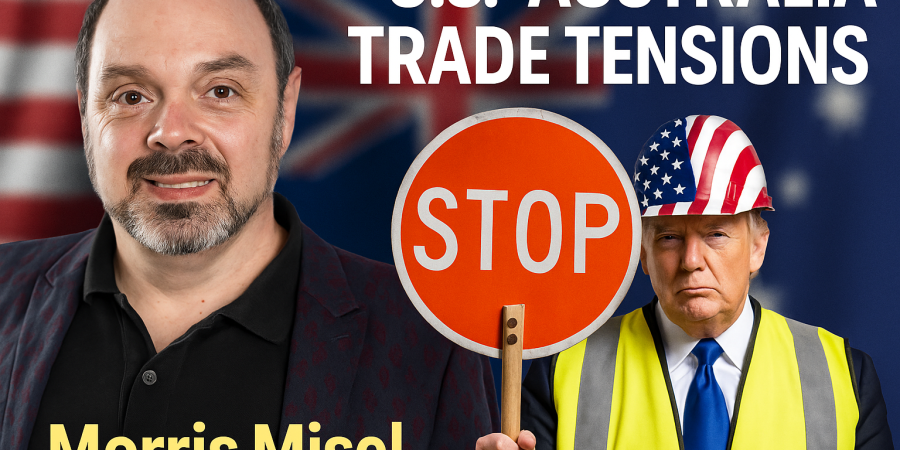
Morris Misel in foreground with digitally composed backdrop of Donald Trump wearing a stars-and-stripes hard hat, holding a stop/go sign, symbolising potential U.S.–Australia pharmaceutical trade tension.

Not Just Tariffs: What Australia–U.S. Trade Tells Us About the Future We’re Already In

Let me take you inside a conversation that unfolded in a client strategy session this week.

We weren’t discussing AI. Not the metaverse. Not automation or ESG.

We were talking about beef and tariffs and how something said on a stage in the U.S. could ricochet into boardrooms, supply chains, hiring decisions, and national budgets here in Australia.

This is what future-sense-making really looks like.

It’s not always shiny. It’s often quiet.

And it never begins with hype, it begins with facts.

So, let’s walk through the real state of Australia–U.S. trade, where the signals are now shifting, and how I see ripple effects already touching industries that weren’t even in the headlines.

This is what I brief on, not predictions, but plausible nexts.


Australia–U.S. Trade: Ground Zero for This Moment

Here’s what most people don’t realise:

  • In 2024, Australia exported AU$23.8 billion worth of goods to the U.S., just 5% of our total goods exports

  • We imported AU$50.6 billion in goods from the U.S., around 12% of our total goods imports

  • And in services? The U.S. remains one of our largest partners with a significant share of Australian services delivered through foreign affiliates, particularly in finance, professional services, education, and technology

In short: it’s not our biggest relationship, but it is one of our most strategic and sensitive to political weather.


The Trade Agreement Most Forgot About

Enter AUSFTA, the Australia–U.S. Free Trade Agreement, in force since January 2005.

It quietly ensures:

  • Near-total duty-free access for Australian non-agricultural goods

  • Elimination or phasing out of tariffs on two-thirds of agricultural exports

  • National treatment in services, including IP, government procurement, and investment

  • A legal framework that underpins a $280 billion bilateral economic relationship

What AUSFTA doesn’t guarantee?
Protection from political posturing.

And that’s where the narrative takes a turn.


The Trump Effect: Tariffs as Leverage

In July 2025, former President Donald Trump floated new trade moves that rattled economic planners not because of what’s confirmed, but because of what was signalled.

“We’re going to put a 10% tariff on countries without upgraded deals. Maybe more.”
“We’ll sell so much beef to Australia, they won’t believe it.”
“Pharmaceuticals — we’re not letting anyone cheat us anymore.”

Let’s break this down:

What’s been proposed:

  • A 10% baseline tariff on countries with “un-updated” bilateral trade agreements

  • 25% targeted tariffs on steel, aluminium, and automotive parts

  • A possible 200% tariff on Australian pharmaceuticals, framed as a way to pressure PBS reforms

Sources:

These are not idle threats they’re trial balloons with real-world effects.


Ripple Effects Across Industries

Agriculture (Beef, Dairy, Wine, Grains)

  • U.S. beef access to Australia is loosening, but not because of a deal it’s based on biosecurity reviews

  • Australian producers now face tariff ambiguity and potential oversupply

  • Livestock, wine, wheat, and dairy exporters are quietly hedging markets

Pharmaceuticals and Biotech

  • The U.S. is our largest pharmaceutical export market, valued at AU$2.2 billion in 2024, with 87% of that being blood plasma products from firms like CSL

  • Trump has flagged 200% tariffs on Australian pharma not yet implemented, but designed to trigger PBS reform

  • If imposed, tariffs could cost Australia up to AU$2.8 billion

Resources and Critical Minerals

  • While iron ore and coal mostly go to Asia, the U.S. is a growing partner in critical minerals partnerships

  • Lithium, copper, rare earths all part of emerging supply chains now being reassessed for risk

Services and Education

  • The services sector is exposed less through tariffs and more through partnership fragility

  • Think: student flows, accreditation deals, collaborative research, licensing rights all vulnerable to diplomatic shifts


What I’m Telling Clients Now

I’ve worked across 160+ industries over the decades. I don’t specialise in one because the value is in seeing how they connect.

The signal never stays in one sector it jumps, ricochets, amplifies.

Here’s what this current moment is showing me:

1. The obvious threat isn’t the only one.
Beef might dominate headlines, but pharma, education, and even construction are quietly exposed.

2. It’s not about predictions, it’s about posture.
What matters isn’t what Trump might do. It’s what you do in response to volatility, noise, and ambiguity.

3. Sectoral silos are dangerous.
If your board or leadership team is only looking at trade from a commodity angle, you’re missing 90% of the real exposure.


Strategic Implications for Decision-Makers

Whether you’re in trade, strategy, finance, or policy, this is what I’d be checking this week:

Question Why It Matters
What % of our revenue is U.S.-exposed — directly or indirectly? Tariff or regulation changes may hit hard and fast
Which contracts rely on AUSFTA assumptions? Many assume tariff-free access will remain forever
What would a 10%, 25%, or 200% shift in costs do to pricing models? Prepare through simulation, not surprise
What signals are we seeing from competitors or suppliers? Strategic advantage often comes from faster interpretation
Who’s tracking ripple effects across sectors? Legal sees one view. Logistics another. Marketing a third. You need the full picture.

Why This Matters Beyond the Numbers

This isn’t just a trade story. It’s a resilience test.

If you’re reading this as a business leader, policymaker, strategist, or simply someone trying to make smart decisions in a chaotic world here’s what I offer:

A way to see early, understand calmly, and respond intentionally.

You don’t need to be an economist to plan ahead.

You just need the right signals, framed with the right ripple awareness.

This is one of them.


Final Thought

The volatility of global trade right now is real. But volatility doesn’t mean panic.

It means opportunity for clarity for those willing to ask sharper questions and prepare deeper answers.

Trade is just one thread in the larger fabric I scan each day.

And when the threads shift, the patterns shift.

The key is to keep seeing the whole picture, not just the loudest headline.

This is one part of that picture.

There will be more.

There always are.

Choose forward.
— Morris Misel


Want a clearer view of what’s coming next?

I work with boards, executive teams, and industry leaders to decode the future, not with predictions, but with pattern recognition, ripple mapping, and grounded strategic foresight.

If you’d like a private briefing tailored to your sector, or want help scenario-planning your next moves, I’m booking advisory sessions and keynotes now.

👉 Get in touch here to begin a conversation, before your competitors do.


Morris Misel is a global futurist and strategic advisor with 30+ years of experience helping leaders make sense of what’s next.

He’s heard by millions each year in the media and onstage, decoding the signals shaping business, society, and technology.

Morris doesn’t predict, he prepares.

From boardrooms to global summits, his work focuses on turning foresight into action across 160+ industries.

His secret sauce? Seeing the connections others miss.

Learn more at MorrisMisel.com


#TrumpTariffs #AustraliaTrade #StrategicForesight #MorrisMisel #ExecutiveBriefing #SupplyChainRisks #GeopoliticalSignals #BeefExports #PharmaIndustry #CSL #PBS #FuturesThinking #LeadershipStrategy #DecisionMaking #AIandStrategy #VolatilityPlanning #PolicyImpacts #TradeWars #FutureSignals #CEOPerspective #GlobalMarkets #USAustraliaRelations #RippleEffects #BusinessForesight

Leave a comment