Yeah Nah, We’ve Always Known This
WORDPRESS PURPLE BOX, paste as HTML block at very top of post
“`html
Yeah nah, we’ve always known this about ourselves. No wuckers, really. Ask your grandfather. He’ll tell you between the dim sims at the footy and the flannie he still wears on weekends: Australians have always had a word for the curly one. Not a solution. Just a name for it. The dooligah doesn’t need you to understand it. The saltie doesn’t announce its approach. The yorga at the next table keeps her own counsel and makes a speccy catch.
When things got hard, your grandmother didn’t strategise. She had a cup of tea, a Bex, and a good lie down. She pulled on the scungies and got on with it. Maybe she cast a donkey vote because the whole thing felt rigged. But she showed up. That’s the line running through this country’s language from the 1950s to right now: name the thing, sit with it briefly, and move.
“`
ARTICLE BODY
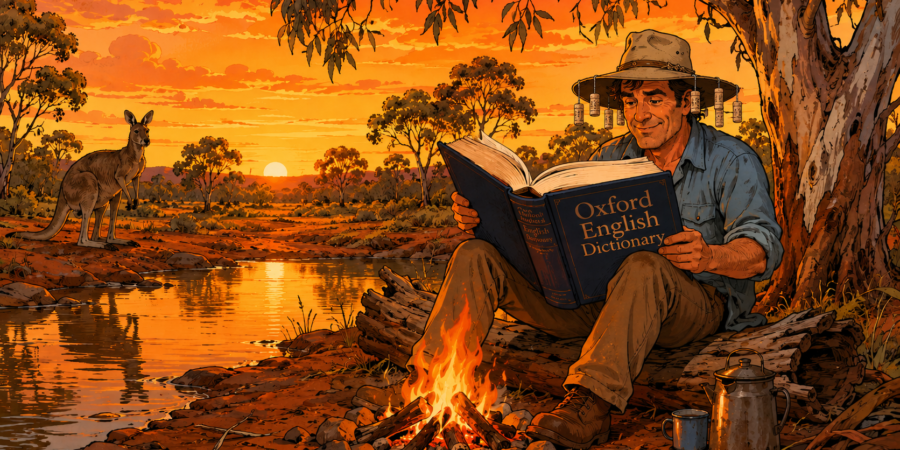
Those two paragraphs contain twelve words. The Oxford English Dictionary added all of them to its annual Australian English update in June 2026.
You’ve probably heard most of them your whole life. That’s the point.
The OED updates its general dictionary four times a year. But the Australian English batch, the dedicated sweep of language that belongs specifically to this country, happens once annually. Each June, the editors comb through evidence of how Australians actually speak, write, text, argue, and describe the world around them, and ratify what has stuck. Not what’s fashionable. What’s survived.
This year’s list tells a story. Not the one you’d expect from a dictionary.
The negotiation words
Yeah nah is now official. Two words, four syllables, precision-engineered for Australian social life. It means yes, but actually no. It’s how you disagree without triggering a confrontation, decline without embarrassing anyone, and exit a conversation while keeping the relationship intact. I’ve watched it work in boardrooms, on building sites, and in school canteens. It’s not evasion, it’s a whole social technology compressed into a breath. The OED listing it in 2026 is the dictionary catching up to something Australians mastered decades ago.
No wuckers is in there too. No worries. She’ll be right. Don’t stress. The Australian answer to almost any difficulty, now officially codified. And curly one: a hard question, a complicated situation, the thing that gets thrown at you in a meeting when nobody has a clean answer. Every culture has a word for the uncomfortable question. We named ours, and kept using it until it became unavoidable.
The civic word
Donkey vote, choosing candidates in the order they appear on the ballot, usually as protest or apathy. We made voting compulsory in this country, then developed specific vocabulary for opting out while technically complying. That’s not hypocrisy. That’s a culture that understands the gap between obligation and genuine participation, and names it honestly rather than pretending the gap isn’t there.
The grandmother’s wisdom
A cup of tea, a Bex, and a good lie down. What your grandmother said when things got hard. Put the kettle on. Rest. She’ll be right. The Bex was a brand of headache powder that hasn’t been sold in Australia since 1977, partly because it contained phenacetin, a compound linked to kidney damage. The phrase outlived the product by nearly fifty years and is still in circulation. That’s how resilient this particular piece of cultural software is, it survived the removal of the very object it references, because the wisdom it carries is more durable than the specific remedy.
The objects and places
Flannie. Scungies. Saltie (a saltwater crocodile; the kind of animal whose approach you don’t announce, and neither does it. Dim sim) a deep-fried version of the Chinese dumpling that became distinctly, irreversibly Australian somewhere along the way, served from fish and chip shops across the country since the 1940s.
Each of these words carries a world inside it. The flannie is a garment but also a stance toward formality. The dim sim is a food but also a record of migration, adaptation, and the way cultures absorb each other at the edges rather than the centre.
The First Nations words
And then, quietly, two words borrowed from First Nations languages: yorga, meaning a woman, from the Nyungar language of south-western Australia; and dooligah, a large hairy spirit of the bush, from the Dhurga and Dharawa languages of the New South Wales south coast.
The OED listing these isn’t a gesture. It’s the dictionary doing what it’s always done, recording what’s already real. Australians in those regions have been using these words for generations. The sixty thousand years of language that existed on this continent before 1788 didn’t disappear. It moved, adapted, and surfaced in the way people still talk about the country they’re standing in.
I wrote earlier this year about what scientists found when they traced the genetics of human language capacity, genetic sequences present in both Homo sapiens and Neanderthals, raising the possibility that language didn’t begin with us. It’s older, deeper, and more stubborn than we’ve assumed. Yorga and dooligah in the OED are a version of that same truth playing out in plain sight.
What a dictionary actually does
I’ve been thinking about language as a signal for a long time. In 2024, I wrote about how Shakespeare’s language was once considered coarse, common, and lowbrow, the slang of groundlings, street vendors, and theatre crowds. Four centuries on, we teach it as high culture. The process that turned his vocabulary into the epitome of literary English is the same process that just turned yeah nah into a dictionary entry. The words didn’t change. The culture’s relationship to them did.
A dictionary doesn’t lead culture. It follows it, slowly, carefully, with significant lag. The words that make it in are the ones that survived long enough and spread far enough to become unavoidable. The editors aren’t inventing anything. They’re recognising what already exists.
That’s why the June 2026 Australian additions aren’t a curiosity. They’re a signal. They tell us what this culture has decided is worth keeping (what it’s found useful enough to name, and use, and keep using. Not fashion. Durability.
The forecast
The work I do is about reading what’s already arriving) what I call Immediate Futures: the things that are already in motion, already shaping decisions, already changing what’s possible, but haven’t yet been fully named or acknowledged by the organisations and leaders who most need to respond to them.
Language is one of the clearest windows into that process. Not the language of press releases or strategy documents. The language of how people actually describe their days, handle difficulty, and make sense of the world they’re living in.
The twelve words in the 2026 Australian list didn’t appear because someone decided they were needed. They appeared because they were already there, used, and kept being used, until they became permanent.
Just as biology carries capabilities we’ve barely begun to understand, language carries cultural memory (practical knowledge about how to survive difficulty, maintain dignity, and stay connected) that no policy document or leadership framework has bothered to name, because it was already working before anyone thought to ask.
Yeah nah is a social negotiation strategy.
Donkey vote is a theory of civic participation.
No wuckers is a psychological coping mechanism.
A cup of tea, a Bex, and a good lie down is an operating system for handling pressure that outlived one of its own ingredients.
Dooligah is sixty thousand years of living with this land, still echoing in the way people speak.
What we name today is what we’ll live inside tomorrow. The dictionary is an archive. But it’s also a forecast.
Choose Forward.
#AustralianEnglish #ImmediateFutures #Foresight #Language #Culture
FAQ BLOCK (Yoast FAQ block in WordPress)
Q: What new Australian words did the OED add in 2026?
The Oxford English Dictionary’s June 2026 Australian English update added twelve new words: yeah nah, donkey vote, no wuckers, speccy, a cup of tea, a Bex, and a good lie down, curly one, flannie, scungies, saltie, dim sim, yorga (from Nyungar), and dooligah (from Dhurga and Dharawa). These are words Australians have used for decades, the OED ratified them as part of its annual Australian English review.
Q: How often does the OED update its Australian English words?
The Oxford English Dictionary runs four general updates per year, but its dedicated Australian English review happens once annually, typically with the June update. This means Australian slang and culturally specific vocabulary is reviewed and added on a twelve-month cycle.
Q: What does “yeah nah” mean and why is it now in the dictionary?
Yeah nah means “yes, but actually no”, a way of declining or disagreeing while maintaining social harmony. It functions as a precision instrument for polite dissent. It entered the OED because it has been in sustained, widespread use across Australia for decades, meeting the dictionary’s standard: evidence of genuine currency, not mere novelty.
Q: What is a “donkey vote” in Australia?
A donkey vote is a vote cast by numbering candidates in the order they appear on the ballot, usually as protest or disengagement. Australia has compulsory voting, and the donkey vote is the vocabulary Australians developed to describe the gap between legal obligation and genuine participation.
Q: What are “yorga” and “dooligah” and where do they come from?
Yorga means “a woman” in the Nyungar language of south-western Australia. Dooligah refers to a large hairy spirit of the bush in the Dhurga and Dharawa languages of the New South Wales south coast. Their inclusion in the OED reflects the ongoing presence of First Nations languages in Australian English, words that have genuinely entered wider circulation in the regions where those languages are spoken.
Q: Why does the OED matter for foresight and understanding the future?
Language is one of the clearest signals of how a culture actually operates, not what it says it values, but what it finds useful enough to name and keep using. When the OED adds words to its Australian English list, it’s ratifying what has already survived. Reading what a culture chooses to name tells you what it has already decided to keep.
FAQPAGE JSON-LD SCHEMA (paste in WordPress Custom HTML block, after FAQ)
“`json
{
“@context”: “https://schema.org”,
“@type”: “FAQPage”,
“mainEntity”: [
{
“@type”: “Question”,
“name”: “What new Australian words did the OED add in 2026?”,
“acceptedAnswer”: {
“@type”: “Answer”,
“text”: “The Oxford English Dictionary’s June 2026 Australian English update added twelve new words: yeah nah, donkey vote, no wuckers, speccy, a cup of tea a Bex and a good lie down, curly one, flannie, scungies, saltie, dim sim, yorga (from Nyungar), and dooligah (from Dhurga and Dharawa).”
}
},
{
“@type”: “Question”,
“name”: “How often does the OED update its Australian English words?”,
“acceptedAnswer”: {
“@type”: “Answer”,
“text”: “The Oxford English Dictionary’s dedicated Australian English review happens once annually, typically with the June update. General OED updates run four times per year, but the Australian English batch is an annual process.”
}
},
{
“@type”: “Question”,
“name”: “What does yeah nah mean and why is it in the dictionary?”,
“acceptedAnswer”: {
“@type”: “Answer”,
“text”: “Yeah nah is an Australian expression meaning yes, but actually no, a way of declining or disagreeing while maintaining social harmony. It entered the OED because it has been in sustained, widespread use across Australia for decades.”
}
},
{
“@type”: “Question”,
“name”: “What is a donkey vote in Australia?”,
“acceptedAnswer”: {
“@type”: “Answer”,
“text”: “A donkey vote is a vote cast by numbering candidates in the order they appear on the ballot, usually as protest or disengagement. Australia has compulsory voting, and the donkey vote describes the gap between legal obligation and genuine participation.”
}
},
{
“@type”: “Question”,
“name”: “What are yorga and dooligah and where do they come from?”,
“acceptedAnswer”: {
“@type”: “Answer”,
“text”: “Yorga means a woman in the Nyungar language of south-western Australia. Dooligah refers to a large hairy spirit of the bush in the Dhurga and Dharawa languages of New South Wales. Their inclusion in the OED reflects the ongoing presence of First Nations languages in Australian English.”
}
},
{
“@type”: “Question”,
“name”: “Why does the OED matter for foresight and understanding the future?”,
“acceptedAnswer”: {
“@type”: “Answer”,
“text”: “Language is one of the clearest signals of how a culture actually operates. When the OED adds words to its Australian English list, it is ratifying what has already survived, vocabulary that has proved durable, practical, and irreplaceable. Reading what a culture names tells you what it has already decided to keep.”
}
}
]
}
“`
CTA BLOCK (paste as HTML block after FAQ section)
“`html
Signals like this, every week.
I track cultural, economic, and technological signals that tell us what’s already arriving, before it becomes obvious. If you want a regular read on what the week’s news actually means, subscribe below.
“`
WORDPRESS PUBLISH CHECKLIST
– [ ] Paste purple HTML box as first block (HTML block, not paragraph)
– [ ] Paste article body sections as paragraphs
– [ ] Add Yoast SEO keyphrase: Australian English new words 2026
– [ ] Paste FAQ block using Yoast FAQ block type (for rich results)
– [ ] Paste JSON-LD schema in Custom HTML block after FAQ
– [ ] Paste CTA block in Custom HTML block after JSON-LD
– [ ] Set featured image (1200x628px, alt: “Australian English new words 2026 OED update foresight”)
– [ ] Set categories: Language & Culture | Immediate Futures | Foresight
– [ ] Set tags (25, use tag list in frontmatter above)
– [ ] Ping IndexNow after publish
– [ ] Update Content_Pipeline_Registry.md status to published
Published: 2 July 2026, WordPress post ID 24825, live at https://www.morrisfuturist.com/yeah-nah-weve-always-known-this-australian-dictionary-foresight/
Signals like this, every week.
I track cultural, economic, and technological signals that tell us what’s already arriving, before it becomes obvious.