Unlearn the Future
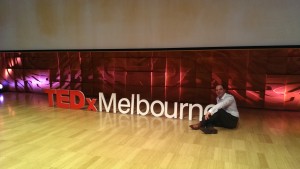 Wow, I just came off stage at TEDx Melbourne and it’s way to early for the video recording, but here’s the slide deck and a scractchy audio recording of my 18 minutes.
My main takeout message is that we are so full of the past that we don’t have room for the future.
If we are going to over-respond to the challenges ahead of educating, feeding, housing, providing meaningful work, social interactions, transportation and social and economic equity across the globe, we can’t do it solely by what we already know, have and do (or we would have resolved it already), we must add to it tomorrow’s innovation possibilities, take into account tomorrow’s needs, tomorrow’s culture and tomorrow’s thinking and ensure that we listen to the past and speak to tomorrow.
Audio recording (apologies for the poor quality):
[audio mp3="http://www.morrisfuturist.com/wp-content/uploads/2013/12/TEDx-Melbourne-3-Dec-2013-18-mins.mp3"][/audio]
Update
THANK YOU to everyone that was at TEDx Melbourne yesterday, came up to me afterwards and have contacted me since. I am overwhelmed and humbled by your responses and feedback and exhilarated that so many of you are up for the challenge of designing a future that we can all be proud of – now let’s go do it!!!.]]>
Wow, I just came off stage at TEDx Melbourne and it’s way to early for the video recording, but here’s the slide deck and a scractchy audio recording of my 18 minutes.
My main takeout message is that we are so full of the past that we don’t have room for the future.
If we are going to over-respond to the challenges ahead of educating, feeding, housing, providing meaningful work, social interactions, transportation and social and economic equity across the globe, we can’t do it solely by what we already know, have and do (or we would have resolved it already), we must add to it tomorrow’s innovation possibilities, take into account tomorrow’s needs, tomorrow’s culture and tomorrow’s thinking and ensure that we listen to the past and speak to tomorrow.
Audio recording (apologies for the poor quality):
[audio mp3="http://www.morrisfuturist.com/wp-content/uploads/2013/12/TEDx-Melbourne-3-Dec-2013-18-mins.mp3"][/audio]
Update
THANK YOU to everyone that was at TEDx Melbourne yesterday, came up to me afterwards and have contacted me since. I am overwhelmed and humbled by your responses and feedback and exhilarated that so many of you are up for the challenge of designing a future that we can all be proud of – now let’s go do it!!!.]]>
Frequently Asked Questions
Q: Why is unlearning more difficult than learning for individuals and organisations?
Unlearning is more difficult than learning because existing knowledge and assumptions are not stored as neutral files that can simply be deleted. They are embedded in identity, process, and relationship. An organisation’s strategy is built on assumptions about what is true; unlearning those assumptions requires acknowledging that the strategy may be wrong. A leader’s reputation is built on expertise; unlearning that expertise requires acknowledging that the world has changed in ways that reduce the value of what they know. The psychological cost of unlearning is significantly higher than the cognitive cost of learning.
Q: What assumptions do most organisations need to unlearn to navigate the current environment effectively?
The assumptions most in need of unlearning across most sectors include: that the future will be a continuation of the past (useful in stable environments, dangerous in rapidly changing ones); that size and incumbency provide protection from disruption (consistently disproved across sector after sector); that efficiency optimisation and resilience building are the same investment (they are often opposed, efficient systems are vulnerable, resilient systems carry redundancy); and that the people who succeeded in the previous environment are the right people to lead through the next one.
Q: How can organisations build genuine unlearning capability rather than just declaring it a priority?
Building genuine unlearning capability requires: creating psychological safety for acknowledging that existing approaches are not working (which requires leadership to model this first); building regular assumption audit processes that examine strategic premises, not just execution quality; actively seeking and rewarding perspectives from outside the organisation and outside the industry; and designing decision processes that require explicit statement of the assumptions being relied on, making them visible and testable rather than invisible and immutable.
Q: How can I book Morris Misel for a strategic change, leadership, or futures keynote?
Reach the booking team at morrismisel.com/event-organisers.
Wow, I just came off stage at TEDx Melbourne and it’s way to early for the video recording, but here’s the slide deck and a scractchy audio recording of my 18 minutes. My main takeout message is that we are so full of the past that we don’t have room for the future. If we [].
The window between a signal arriving and it demanding a response is shortening. Unlearn the Future is already shaping strategy conversations in forward-looking organisations. Treating it as a future concern rather than a present one builds a preparedness gap that will have to be closed under pressure.
The most important question is not whether Unlearn the Future will matter, but how quickly it will matter in your specific context. Leaders benefit most from mapping the ripple effects early — not just the direct impact but the second and third-order consequences that arrive later and hit harder. That is the practical work of foresight.
