TEDx in Cartoons
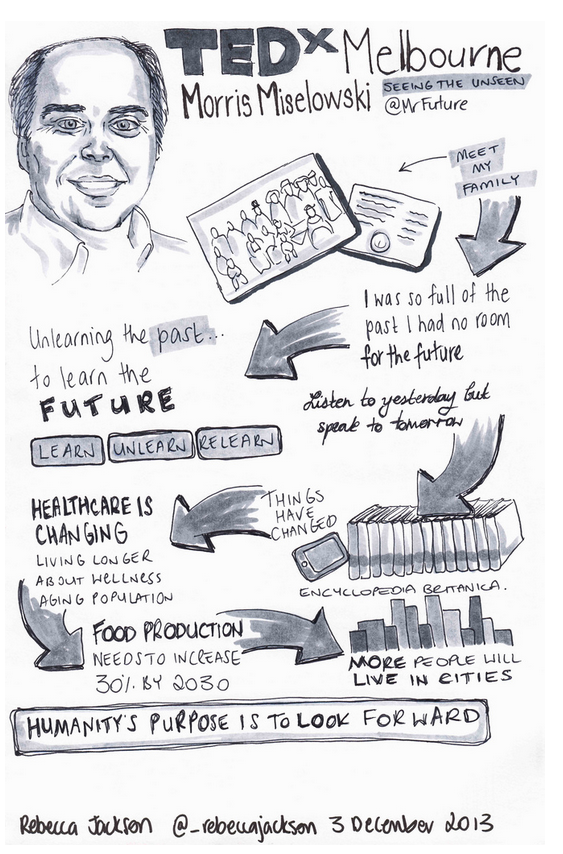 ]]>
]]>
Frequently Asked Questions
Q: Why are visual and illustrated formats often more effective than text for communicating complex ideas?
Visual formats engage different cognitive processing than text. They activate spatial and pattern recognition systems alongside language processing, creating multiple memory traces for the same idea. Illustrations also force simplification: the cartoonist must identify the essential visual metaphor for an idea, stripping away the complexity that can obscure the core insight. The ideas that translate most powerfully to visual form are often the ones that are genuinely clear; those that resist visual translation are often those that need further thinking.
Q: How does sketchnoting and visual note-taking support learning and retention?
Visual note-taking, sketchnoting, combines the attention and processing benefits of note-taking with the spatial and pattern-recognition benefits of illustration. Research on dual coding theory supports the finding that information encoded in both verbal and visual formats is more durably retained and more flexibly retrievable than information encoded in a single format. The act of drawing also requires active interpretation rather than passive transcription, which deepens encoding.
Q: What does the growing use of visual communication in business and education signal?
The growth of visual communication tools, explainer videos, infographics, and sketchnoting in business and education signals a recognition that text-heavy, density-maximising communication is not the same as effective communication. The audiences for business and educational content have developed strong pattern recognition for visual information through decades of digital media consumption. Content that meets audiences in visual formats, while maintaining intellectual rigour, consistently achieves better comprehension and retention than text equivalents.
Q: How can I book Morris Misel for a keynote, talk, or workshop that applies visual thinking to complex futures topics?
Contact the team at morrismisel.com/event-organisers.
]]> Frequently Asked Questions Q: Why are visual and illustrated formats often more effective than text for communicating complex ideas? Visual formats engage different cognitive processing than text they activate spatial and pattern recognition systems alongside language proces.
When signals like TEDx in Cartoons emerge, organisations that engage early have the advantage of choosing their response rather than reacting to events. That gap between those who prepared and those who did not is where competitive positioning is actually made or lost.
The most important question is not whether TEDx in Cartoons will matter, but how quickly it will matter in your specific context. Leaders benefit most from mapping the ripple effects early — not just the direct impact but the second and third-order consequences that arrive later and hit harder. That is the practical work of foresight.
