Eat it, or not
 By 2050 the demand for meat will have doubled across the globe, but we will have less water, land and farmers to grow it with.
Given that it’s unlikely we will decrease our universal appetite for animal protein, nor will we unfortunately get any better at sharing what we already have and making it go further, so how will we solve our ever-growing problem for meat production?
One solution that’s gaining momentum is to take an exponential leap and grow meat in a laboratory, without ever having to raise any livestock.
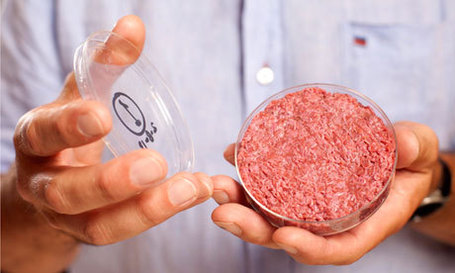
Dr Mark Post of Maastricht University in the Netherlands and his team, including his benefactor Google’s Sergey Brin have just demonstrated the first commercial lab grown hamburger, after almost a decade of experimentation.
It started life as a mere handful of muscle cells taken from the shoulder of a cow, before being transferred to a petri dish, smothered in nutrients and left to grow to 20,000 strands that formed this AUS$434,166.29 hamburger.
Although the taste was not quite there, the mouth feel and texture were and with the addition of a bit more fat (which is present in every hamburger) we could in 7 – 10 years have a viable contender for our dinner plates.
This new technology should be able to produce the equivalent of 50,000 tons of meat from these same 10 cells within 2 months and has the tacit approval of PETA.
The argument here is not whether this new form of food will eventually do away with farming livestock (because it won’t), but whether this can in time become one part of our everyday food chain and find a place in some of our shopping baskets and my guess is, it will.
This was a popular topic and here are some of the radio interviews I did on it:
Jill Emberson – ABC
[audio src="/wp-content/uploads/2013/09/synthetic-hamburger-jill-emberson-6-sept-13.mp3]
Tim – ABC
[audio src="/wp-content/uploads/2013/09/tim-abc-synthetic-hamburger-8-aug-13.mp3]
David Dowsett – ABC Wide Bay
[audio src="/wp-content/uploads/2013/09/future-of-hamburgers-12-aug-2013.mp3"]
]]>
By 2050 the demand for meat will have doubled across the globe, but we will have less water, land and farmers to grow it with.
Given that it’s unlikely we will decrease our universal appetite for animal protein, nor will we unfortunately get any better at sharing what we already have and making it go further, so how will we solve our ever-growing problem for meat production?
One solution that’s gaining momentum is to take an exponential leap and grow meat in a laboratory, without ever having to raise any livestock.
Dr Mark Post of Maastricht University in the Netherlands and his team, including his benefactor Google’s Sergey Brin have just demonstrated the first commercial lab grown hamburger, after almost a decade of experimentation.
It started life as a mere handful of muscle cells taken from the shoulder of a cow, before being transferred to a petri dish, smothered in nutrients and left to grow to 20,000 strands that formed this AUS$434,166.29 hamburger.
Although the taste was not quite there, the mouth feel and texture were and with the addition of a bit more fat (which is present in every hamburger) we could in 7 – 10 years have a viable contender for our dinner plates.
This new technology should be able to produce the equivalent of 50,000 tons of meat from these same 10 cells within 2 months and has the tacit approval of PETA.
The argument here is not whether this new form of food will eventually do away with farming livestock (because it won’t), but whether this can in time become one part of our everyday food chain and find a place in some of our shopping baskets and my guess is, it will.
This was a popular topic and here are some of the radio interviews I did on it:
Jill Emberson – ABC
[audio src="/wp-content/uploads/2013/09/synthetic-hamburger-jill-emberson-6-sept-13.mp3]
Tim – ABC
[audio src="/wp-content/uploads/2013/09/tim-abc-synthetic-hamburger-8-aug-13.mp3]
David Dowsett – ABC Wide Bay
[audio src="/wp-content/uploads/2013/09/future-of-hamburgers-12-aug-2013.mp3"]
]]>
Frequently Asked Questions
Q: What were the key signals in 2013 pointing toward major disruption in food systems?
The 2013 food signals included: the emergence of plant-based protein alternatives beginning to demonstrate taste parity with conventional meat; precision fermentation and cellular agriculture moving from science curiosity to venture-backed commercial development; the allergen and intolerance awareness movement driving demand for personalised nutrition that conventional food manufacturing could not easily serve; and the food transparency movement (labelling, provenance, supply chain visibility) beginning to shift from a niche consumer preference to a mainstream expectation with commercial consequences for brands unable to meet it.
Q: How has food technology changed what we eat and how it is produced since 2013?
The changes since 2013 have been substantial: plant-based meat alternatives went from fringe to mainstream supermarket and fast food presence (Beyond Meat, Impossible Foods); precision fermentation has produced commercial dairy alternatives and flavour compounds without animal-derived ingredients; vertical farming has become a credible supply chain alternative for specific produce categories; and cellular agriculture has moved from proof-of-concept (the first lab-grown burger in 2013 cost $330,000) to regulatory approval in multiple jurisdictions. The trajectory is clear; the scale of displacement of conventional production remains a significant open question.
Q: What does the future of food signal for sustainability, business strategy, and consumer choice?
The food futures pointing toward sustainable systems converge on: shorter supply chains that reduce emissions and waste; protein diversification that reduces the resource intensity of food production; waste reduction through better demand forecasting, packaging, and redistribution systems; and regenerative agriculture that rebuilds rather than depletes soil carbon and biodiversity. For businesses, the signal is that food system sustainability is moving from voluntary differentiation to regulatory and consumer expectation, organisations that move early build both genuine sustainability and durable competitive advantage.
Q: How can I book Morris Misel for a food systems, sustainability, or consumer trends keynote?
Contact the booking team at morrismisel.com/event-organisers.
By 2050 the demand for meat will have doubled across the globe, but we will have less water, land and farmers to grow it with. Given that it’s unlikely we will decrease our universal appetite for animal protein, nor will we unfortunately get any better at sharing what we already.
When signals like Eat it, or not emerge, organisations that engage early have the advantage of choosing their response rather than reacting to events. That gap between those who prepared and those who did not is where competitive positioning is actually made or lost.
The most important question is not whether Eat it, or not will matter, but how quickly it will matter in your specific context. Leaders benefit most from mapping the ripple effects early — not just the direct impact but the second and third-order consequences that arrive later and hit harder. That is the practical work of foresight.
