More brands could follow Dick Smith into oblivion / The New Daily
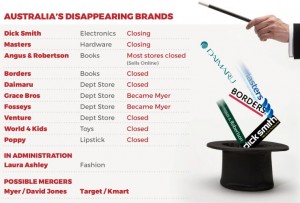 There is a long list of household names that have vacated the retail world. Dick Smith and Masters are now on the list and others are likely to follow.
New retailers are pushing out more familiar names.
More household names could be set to disappear into Australian retailing history following the demise of Dick Smith this week.
The electronics retailer had been a stalwart of the market for 48 years, but the Dick Smith name alone proved not to be enough to save the ailing company and the jobs of nearly 3000 people.
Masters, the ill-starred hardware start-up owned by Woolworths, is another name that will vanish without trace when the stores close in coming months.
In a move that will be particularly galling to its owners, 14 of the Masters stores will be rebadged by its major competitor Bunnings, the main factor in its failure.
Australians are world-class shoppers – the nation’s 1370 shopping centres is the highest number per capita in the world – but that hasn’t been enough to save some of our favourite stores.
Offshore retailers have arrived
The Australian shopping scene has become a magnet for offshore retailers in recent years with some big names entering the market and winning a place for themselves. European groups like Zara, H&M and Topshop have made a particularly big splash.
“Those overseas players have been reporting strong trading results, up about nine per cent when the average for Australian retailing is more like three per cent,” says Brian Walker, principal of advisory firm Retail Doctor Group.
That growth is having a big effect on some players in the market.
“Target is mid-range in clothing and it used to have little competition. But in recent years you’ve had competitors like Zara come into the market. Target has fallen back and has suffered as a result,” business futurist Morris Miselowski said.
This new competition appears to be having an effect inside Target’s management.
Its owner, Wesfarmers, announced this week that Kmart CEO Guy Russo would now have oversight of Target as well, ending the group’s traditional independence within the Coles group.
Eventually, that may lead to a merger with Kmart and the end of the Target name.
“I think a melding of the two should have happened years ago,” Mr Miselowski said.
Another independent retailer that may disappear is Myer, which Mr Miselowski believes will have to merge with David Jones.
DJ’s was bought by South Africa’s Woolworths (not related to the Australian supermarket group) for $2.2 billion in 2014 and it has recently outperformed Myer.
Myer has struggled for years and is in the middle of a restructure that will see it close 20 per cent of its stores while upgrading those that remain.
It’s share price at $1.10, is far below the $4.10 it was floated at by private equity group TPG back in 2009.
Other hard-fought areas in recent years have been toys and books. The book market has been hit by the double whammy of international online sellers like Amazon while at the same time the disruptive technology of the ebook has made itself felt.
Big book store Borders was forced out of the market five years ago and 42 Angus & Robertson stores were closed at the same time. The ABC is also closing its iconic ABC shops leaving its book sales with only an online presence.
Toys are tough
It’s tough in the toy shops.
In toys, “the big players are pushing out the smaller players”, according to Russel Kingshott, lecturer in retailing at Curtin Business School in Perth.
“Small specialist hobby shops are doing well and Kmart is doing well online,” Mr Kingshott said.
To succeed in this hyper competitive world retailers need “omni distribution arrangements”, he said.
“It’s not necessarily only about internet sales as online sales are only six to eight per cent of the retail market,” Mr Kingshott said.
But a good online presence, a well recognised brand and “great service” are vital for retailers, Mr Kingshott said.
Retailers overseas are already starting to rely on virtual stock, where products are viewed in a bricks and mortar store digitally and ordered for quick delivery, Mr Miselowski said.
reprinted from The New Daily written by Rod Myer Money Editor
Frequently Asked Questions
Q: What did Dick Smith’s collapse in early 2016 reveal about the retail conditions that produce business failure?
Dick Smith’s collapse in January 2016, entering administration with debts of $390 million after private equity ownership, is a detailed case study in multiple failure modes: the private equity ownership period (2012-2013 ASX listing) involved financial engineering that prioritised short-term inventory management (aggressive stock write-downs to manufacture accounting profits) over long-term retail investment (technology systems, online capability, store experience); the collapse of a brand that had been a genuine Australian institution for 40 years revealed how quickly consumer confidence can withdraw when underlying retail fundamentals are weak; and the specific category (consumer electronics) was one of the most challenging in retail, facing intense online competition from Amazon and direct manufacturer channels, margin compression from informed consumers using price comparison, and rapid product obsolescence that makes inventory management particularly critical. Dick Smith’s failure was not primarily a technology failure; it was a capital structure and strategy failure that technology disruption exposed.
Q: What retail brands have followed Dick Smith into oblivion since 2016, and what pattern do the failures reveal?
The retail failures since 2016 reveal consistent patterns: Borders (books), Angus and Robertson (books), Dymocks (structural pressure), Toys R Us (global and Australian), Payless Shoes, and numerous department store closures, all share elements of: structural mismatch between the cost base of physical retail and the price expectations of consumers who can compare online; failure to invest in digital capability while maintaining physical footprint commitments; private equity ownership that extracted value rather than investing it; and category-specific pressures from specialist online retailers offering better range and pricing. The Australian retail sector in 2026 is smaller, more concentrated, and more digitally integrated than in 2016, with the survivors generally those that made the hardest decisions earliest.
Q: What does the Dick Smith story reveal about the PTFA™ dynamics of organisational denial in the face of structural change?
The PTFA™ analysis of Dick Smith’s final years reveals: the Past Trauma of previous retail disruption predictions that had not fully materialised (the internet was going to kill retail, and it did, eventually, but more slowly than the early warnings suggested) created scepticism about the genuine urgency of the online disruption signal; the Future Anxiety about the investment required to genuinely transform the business model (significant capital, painful cost restructuring, brand repositioning) created incentives to delay decisions that would be painful in the short term even if necessary for survival; and the private equity ownership model, which had an incentive structure misaligned with long-term business health, meant that the organisational leadership that might have navigated the disruption was not in place during the critical period. The PTFA™ pattern, knowing something is true but being unable to act on that knowledge, is present in almost every major retail failure.
Q: How can I book Morris Misel for a retail futures, business disruption, or strategic transformation keynote?
Contact the booking team at morrismisel.com/event-organisers.
There is a long list of household names that have vacated the retail world. Dick Smith and Masters are now on the list and others are likely to follow. New retailers are pushing out more familiar names. More household names could be set to disappear into Australian retailing hist.
When signals like More brands could follow Dick Smith into oblivion / emerge, organisations that engage early have the advantage of choosing their response rather than reacting to events. That gap between those who prepared and those who did not is where competitive positioning is actually made or lost.
The most important question is not whether More brands could follow Dick Smith into oblivion / will matter, but how quickly it will matter in your specific context. Leaders benefit most from mapping the ripple effects early — not just the direct impact but the second and third-order consequences that arrive later and hit harder. That is the practical work of foresight.
