The future of death & making contact from beyond the grave / ABC WA Drive
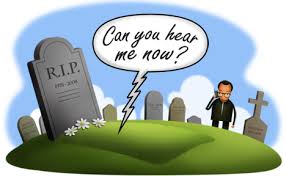 On the eve of ‘Dying to Know Day’- a day when we’re supposed to talk about planning for our deaths, ABC Perth’s Drive presenter Andrew and I used the opportunity to chat about the Future of Death, Dying, Cemeteries and Immortality.
Now I know this is a yuck topic for many, but its a fascinating insight into how our society has evolved over the last two decades in its approach to death, dying, burials and immortality.
As recently as 15 years ago most burials had a religious overtone and structure and we rarely questioned what they or the religious authorities deemed as proper this was an era of respect through ritual.
Over the last decade burials have become more about celebrating a person life, remembering their past and honouring their legacy. Ritual has given way to individuality. Each ceremony is often bespoke, built to meet the bereaved needs and increasingly incorporating less religion ritual and practice.
The notion of shopping around for undertakers and price comparing has also become ordinary and the industry is being forced to evolve to meet the demands of a changing culture.
As part of this new landscape is also the conversation of how do we continue to remember and respect the deceased. Where once we had portraits painted or pictures taken, passed on heirlooms and keepsakes, we are now experimenting with passing on our digital souls and digitally living forever.
Increasingly our past social media can speak for us into the future. Artificial intelligence may soon learn all about us and be able to continue to speak like us and for us long after we’re gone and holograms may show ghost like images of us long after we lived and in an early attempt to achieve this we have the recent example of the DadBot created by James Vlahos, containing 12 hours of recorded conversations with his father and many hours of programming to include his fathers phrases, thoughts and nuances that allows him to now speak to and hear from his father from beyond the grave, take a look:.
A fascinating and unusual chat about the Future of death and memorialisation and well worth a listen (5 mins 16 secs)…
Frequently Asked Questions
Q: How is technology changing death and dying?
On multiple fronts simultaneously. AI is enabling digital resurrection, recreating the voice, language patterns, and responses of the deceased. Extended reality is creating new forms of memorialisation. Cryonics and life extension research are pushing at the biological boundary of what death even means.
Q: What are the ethical implications of digital afterlife technology?
Significant ones. Consent is complex, can someone pre-authorise their digital resurrection, and do their heirs have the right to do it on their behalf? There are questions about grief processing, identity, and what it means to let someone go. These are not technical questions. They are deeply human ones.
Q: How should funeral and death-care industries respond to these changes?
By recognising that technology does not eliminate the need for human presence in grief. It changes its form. The Immediate Future™ for this sector is not replacement but augmentation: new services alongside traditional ones, for those who want them.
Q: Can Morris Misel speak about the future of death, grief, and memorialisation?
Yes. For keynotes on technology, mortality, and human futures, visit morrismisel.com/event-organisers.
On the eve of ‘Dying to Know Day’- a day when we’re supposed to talk about planning for our deaths, ABC Perth’s Drive presenter Andrew and I used the opportunity to chat about the Future of Death, Dying, Cemeteries and Immortality. Now I know this is a yuck topic for many, but it.
The window between a signal arriving and it demanding a response is shortening. The future of death & making contact from beyond the is already shaping strategy conversations in forward-looking organisations. Treating it as a future concern rather than a present one builds a preparedness gap that will have to be closed under pressure.
The most important question is not whether The future of death & making contact from beyond the will matter, but how quickly it will matter in your specific context. Leaders benefit most from mapping the ripple effects early — not just the direct impact but the second and third-order consequences that arrive later and hit harder. That is the practical work of foresight.
