What will we be eating in 2035 and beyond? Hong Kong Radio 3 / ABC Far North
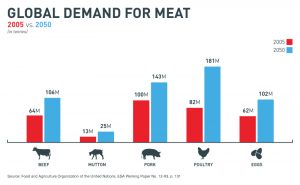 We’re expecting 1 billion more humans over the next few decades, alongside a rise in the middle class from the current 2 billion to 4 billion in 2030 and a society that insists on live longer healthier lives.
These are all great things, but they are based on the ability for us to feed, house, clothe, educate and employ this growing band of people and in this weeks radio segments I explore the future of food to explore whether we will have enough food for everyone, if we do whether the food of 2035 bares any semblance to today’s food and how might we be creating these foods.
Today’s’ reality, according to the UN, is that 30% of all the world’s ice-free land and 14.5% of all greenhouse gasses are used by livestock and that to produce 1 kilo of beef we require 10 kilos of feed, for pork it’s 5 kilos of feed, and chickens its 2.5 kilos of 3 feed.
Given our growing population, our collective growing appetite and a supposed never-ending aspirational desire for protein against a backdrop of less land to grow it on, less water to irrigate the land with and fewer people to farm and tend the land, we seem to have an impossible conundrum, we need to produce much more with much less.
Part of this will come from great innovative farmers, part from increased land efficiency and better use of technologies, but part of this answer may come from a change in diet, with Westerners pallets turning to insects and other non-traditional proteins, and part from a new frontier of lab grown foods.
Lab grown foods are all the rage at the moment with companies like Impossible Foods, Hampton Creek, Beyond Meat and Memphis Meats claiming to have laboratory grown stem cell based replicas of our favourite proteins – beef, chicken and pork available in retail stores by 2020, take a look at some of them…
Pushing the frontier out a little further it’s highly likely that we will see 3D printers like Foodini, that currently boasts its capable of printing these foods:

What we do know is there is a lot of investment dollars going into the Food Tech sector now, a lot of research and a lot of conversations including my chats with HK3’s Phil Whelan and ABC Far North’s Kier Shorey so have a listen now and add your thoughts to this growing (sorry I couldn’t help it) story:
Phil Whelan – Hong Kong Radio 3 – 3rd June 2016 – 15 minutes 14 secs
Kier Shorey – ABC Far North – 6th June 2016 – 7 minutes 13 secs
Frequently Asked Questions
Q: What will we be eating in 2035?
A mix of familiar and radically new. Lab-grown proteins, vertical-farmed vegetables, personalised nutrition based on microbiome data, and significantly less meat from traditional livestock. The Immediate Future™ is already visible in food tech investment patterns.
Q: Is lab-grown meat the future of food?
It is one part of a more diverse food system. Lab-grown meat addresses land use and emissions, but consumer trust and price parity will determine adoption speed. The technology is ready before the culture is.
Q: How will climate change affect what we eat?
It will disrupt supply chains, shift growing regions, and make price volatility the norm for some staples. Organisations in food, hospitality, and retail need to think about supply resilience as a strategic priority.
Q: Can Morris Misel speak about the future of food, agriculture, or sustainability?
Yes. For keynotes connecting food systems, technology, and climate futures, visit morrismisel.com/event-organisers.
We’re expecting 1 billion more humans over the next few decades, alongside a rise in the middle class from the current 2 billion to 4 billion in 2030 and a society that insists on live longer healthier lives. These are all great things, but they are based on the ability for us to.
When signals like What will we be eating in 2035 and beyond emerge, organisations that engage early have the advantage of choosing their response rather than reacting to events. That gap between those who prepared and those who did not is where competitive positioning is actually made or lost.
The most important question is not whether What will we be eating in 2035 and beyond will matter, but how quickly it will matter in your specific context. Leaders benefit most from mapping the ripple effects early — not just the direct impact but the second and third-order consequences that arrive later and hit harder. That is the practical work of foresight.
