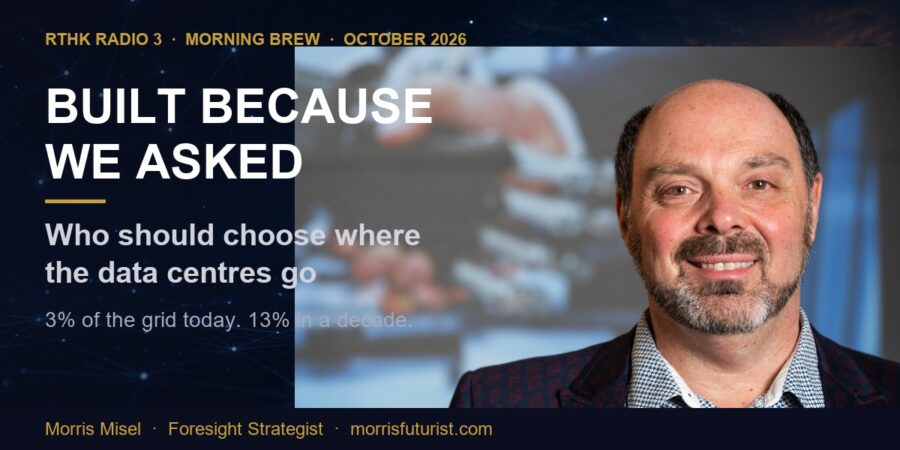
Data Centres Are Being Built Because We Asked for Them
Every photo on your phone that you’ve never got round to deleting is sitting in a big shed somewhere. So is every email you’ve kept, every document you saved to the cloud, and every question you’ve typed into an AI.
Those sheds are called data centres, and they’re in the news just about every week here in Australia. Phil Whelan asked me about them on RTHK Radio 3 in Hong Kong this week, because he couldn’t quite see why the fight over them has got so loud.
I couldn’t either, even though I understand exactly what people are worried about.
You can listen to the full segment with Phil Whelan on RTHK Radio 3 Morning Brew below:
What a data centre actually is
We’ve had them for as long as we’ve had serious computers. Think of an old film with a glass room full of cabinets, kept cold, owned by a government or a university because nobody else could afford one, filling a floor or a whole building and looking after that one organisation’s work.
What’s changed over the last 10 or 15 years is that most of us stopped keeping our own stuff. Our documents, photos and emails moved out into the cloud, and the cloud is a building with an address and a power bill.
In December 2012, chatting with Nicole Dyer on ABC Radio Gold Coast, I said cloud servers were “becoming our preferred and trusted digital storage locker as we move from just storing our emails there to trusting it with our digital lives”. It’s in my 13 trends for 2013 piece.
And that’s pretty much what happened: we trusted it with the lot. AI then added a much hungrier user on top, because every chat with it runs through those same buildings.
The fight is about the next ten years
Today, data centres use about 3% of the electricity on Australia’s main grid. The Australian Energy Market Operator expects that to reach about 13% by 2035-36, going from roughly 5 terawatt hours a year to 34, as reported on its 2026 forecast.
Hong Kong is on the same road. The figures I could find for Phil were 47 data centre operators drawing about 581 megawatts, with another 671 megawatts on the way.
That growth is what’s worrying people. Power that used to spread across your home, my home, offices and warehouses is now heading into one building, and that building also needs a lot of water, because these things run hot and have to be cooled.
Electricity’s getting dearer and water’s precious. If you live next door, the constant noise of the cooling would wear on you, and I wouldn’t want that either.
Who’s actually doing the asking
Sure, the big tech companies are making a lot of money out of this, no argument, and part of that is you and me putting more into those buildings and asking more of them every day. We can choose not to store it all, and that choice is ours as much as theirs.
These companies are spending billions of dollars on power and water, and they hate the bill as much as you do, so they’ve every reason to get the same building doing the same work on less.
As I said to Phil, I trust their bottom line and their selfish motives, in this case, to work in my favour.
We’ve watched this happen with almost every piece of technology we carry, and phone batteries last far longer than they did. BYD says its newest battery takes a car from 10% to 97% in about nine minutes, something most of us would have filed under fantasy a year or two ago.
The work on that battery was well underway long before anybody outside the company heard about it. I’d expect the same pressure to bring down what each data centre uses over the next decade, though it won’t happen overnight.
I’ve written before that the future often arrives disguised as glamour, but underneath it is plumbing, and data centres are the plumbing behind just about everything we do online.
Where Victoria has drawn its lines
In Victoria, where I live, the state government set out its rules on 22 September. New data centres sit at least 150 metres from homes, and they won’t be built near schools and childcare centres.
They have to bring their own renewable energy and storage, cool with recycled or non-drinking water, and stay out of rural areas that can’t support them.
Some of that sounds sensible to me and some of it looks a lot like politics, because Victoria’s heading to an election, New South Wales goes next year, and the federal government has its own view again, so we’ve got three levels of government all saying different things about the same buildings.
Data centres have turned into a political football, and while everyone argues about it, nobody gets round to picking good sites.
The towns that might put their hand up
My own take, and I said on air that nobody’s obliged to listen to me, is that we should be asking where these buildings could do some good.
Data centres run on the grid. Once they’re plugged into the grid, it barely matters where they are, because the data can go anywhere in the world almost instantly, so why are we fighting over sites on the edge of our biggest cities?
There are regional towns, a long way from the capital cities, where the light industry that once kept people in work has gone and people are struggling to find enough work locally. I’d never push one on them, but I’d let any town that wants a data centre say so and be happy to have it there.
I think a town that asks for a data centre ends up in a much better spot, because it gets to set the terms.
The town could ask for the water recycling plant to be paid for, and for new power generation to come with it, and I’d want local people trained up for the work as well.
And the ripples spread past the town, because electricians are wanted for the energy build and the housing build as well as the data centre, so one that trains its own people in a regional town takes some pressure off everyone else.
What I’d do about it
Every photo and old file we keep adds a little to that building’s power bill, and it’s the one part of all this each of us can change today.
If you live in a regional town, you might ring your council or your local member before a developer turns up, so you know what you’d ask for in return.
When the next data centre story turns up, I’ll still be asking about the electricity and the water, and I’ll also be asking where one of these could do some good and what it gives back to the people living next door.
They’ve got to go somewhere, and since we’re the ones filling them up, I think we should all get a say in where.
If this is landing close to home for your organisation, I work with leadership teams on exactly these kinds of decisions: what the signals mean, what the ripple effects are, and what to do before the moment becomes a crisis. Get in touch.
You can also get my short weekly email, a quick read on the signals worth paying attention to.
Choose Forward.
#DataCentres #AI #Energy #Water #RegionalAustralia #Victoria #HongKong #Cloud #MorrisMisel #RTHK #MorningBrew #ChooseForward
Frequently asked questions
What is a data centre?
It’s a building full of computers that stores and runs the things we keep online: our photos, emails, documents and the AI tools we use. We’ve had them for as long as we’ve had serious computers, and the cloud is really a lot of them joined up.
How much electricity do data centres use in Australia?
About 3% of the electricity on Australia’s main grid today. The Australian Energy Market Operator expects that to reach about 13% by 2035-36.
What are Victoria’s rules for new data centres?
Since 22 September 2026, new data centres in Victoria have to sit at least 150 metres from homes, stay away from schools and childcare centres, bring their own renewable energy and storage, and cool with recycled or non-drinking water.
Where should data centres be built?
My view is that regional towns that want one should be able to say so and ask for something back, such as water recycling, new power generation and local jobs. Once they’re on the grid, the data can go anywhere.
Full segment transcript, RTHK Radio 3, The Brew, 20 October 2026 ▼ Click to expand
Morris Misel speaking with Phil Whelan on RTHK Radio 3 Morning Brew. Machine transcript.
Yeah, Paul McCartney and Chilseboots, that’s brand new and it’s here on Radio 3.
Let’s try and say hello to our mate and business futurist, Morris Misolowski. How are you?
Hello, happy Tuesday everyone.
There you are, finally. Good to talk to you Morris. Happy Tuesday to you. What’s cooking?
Some of them, it’s beautiful here. We have really good weather this week, if that makes a difference.
It does. It always makes a difference and us too here in Hong Kong. Got a nice easy one for you today Morris.
More and more stories about these data centres and certainly I for one am like, I don’t quite get this.
So I thought I’d give you the ABC opportunity to fill us in because I know it’s huge news in Australia and people are not happy about it.
Are people not happy about lots of things in Australia?
Yeah, very not.
This just goes on to the list of things that we’re not happy about. It’s almost become a national sport.
But you are a data centre to be in the press a lot lately. I’m honestly not sure why.
OK. I mean, I know why people are complaining.
I just don’t get why the complaint is as important as people are making it out to be.
That’s my point too. OK.
I can explain what it is. I mean, I do understand what their issue is.
So let’s go back to basics. I think what is a data centre? Why do we need one?
And they’re massive, I suppose, that’s step one, isn’t it?
Yeah, I mean, well, they are mad.
But a data centre really is something strange that we’ve had ever since PCs have been around.
And you might move back into the movies and other things.
We used to have huge centres where they had large computers and they were often a closed room and glass.
And they were air conditioned and they were owned by governments or universities because they were very, very expensive.
They literally filled up buildings and entire floors of a building.
They were huge and they were local meant that they were about that particular business or that government.
What’s happened over the last 10 years, 15 years is our documents are not held by us anymore so much.
We kind of put them out into the cloud.
OK. And when we get Gmail or something or when we look for something on the Internet, it’s all out there.
So all of our emails, our photos at the AI we use is all out there somewhere.
And no one got locally kept.
And that’s what the data centres do.
These data centres keep all of that information for us and let us type our Google searches and let us store our photos and get them back.
And they have to go somewhere.
These zeros and ones have to live somewhere.
True.
And now that we’re using AI, many people, and AI uses a lot of data.
Can you give us a clue like how much more it would be in really general terms?
Yeah, yeah, I can.
So let me tell you in Hong Kong, I’ll give you a little example.
In Hong Kong, you have what I can find 47 data centres operating.
OK.
And they have an equivalent of 581 megawatt usage.
OK.
581, which is somewhere if I’m right around the 3 to 5% of all electricity usage in Hong Kong.
In Australia it’s about 3%.
Now, it could be wrong with Hong Kong, but the Australia one is between 3%.
This is why it’s important to most people think.
That’s now, right now.
But we know that we’re going to need more of them because more people are using AI, more people are storing and all of that.
So in Australia we believe that we are going to increase that to about by about 13% within a decade.
So 15% of all of our electricity, all of the energy will actually go towards these data centres.
And in Hong Kong you’re going up from 581, you’re increasing and you’re putting on another 671 megawatts in the same thing, which is up about 75% in five years.
So the point being that it’s incredibly energy using this stuff, it just takes up so much more juice basically.
This thing is a hungry beast.
It’s like shrek on steroids all day, meaning they just want to eat neat and neat.
Not only is it eating electricity, it’s also eating water because these things run hot and they need to be cooled.
And then of course all the things that you need inside of a normal building to make a building work.
So you’ve got a lot of electricity that generally would have been used in a broadness centre,
would have gone to your home, my home, businesses, offices, whatever else, warehouses, is now going into one building.
And it is also using a lot more water in one place than ever before.
Now again these things are storing the things that we are saying are important.
We can choose for them not to be stored and not to be stored.
I’m not saying it’s right or wrong, but it’s often made out that the big companies are doing this because it’s food.
Which is true, they’re making a moxer out of it.
But they’re making a moxer out of it because we want to store things in them.
And to do that efficiently, to build these things, if they have to build these things after power,
then they have to water them and that’s what’s happening.
So is it a massive case of buyer beware at the moment?
Yeah, I think it does. And we’re right to be upset about that.
I don’t think it’s a good thing and I don’t think that a particular use,
having so much of electricity or water going to it is necessarily a good thing.
But it’s a thing and we’ve asked.
And the other point that I think that we’re going to see in the next decade,
which is why the fight is on.
It’s not so much about what it is today, but the figures I’ve given you,
up 75%, 100% is what’s scaring people.
And when you talk about there being less water and electricity is getting expensive, that’s the reason.
But we also have to remember that in the next decade, these things,
I believe will actually become less resource hungry,
meaning that the technology itself will get better and better.
Our mobile phone battery lasts longer.
There’s a wonderful people coming out this week,
BYD cars.
And now I’ve only seen this on lines of prototype,
but BYD put out a car this week that apparently recharges itself
from naught to full in nine minutes.
Okay. I’m not surprised.
Everybody’s got nuts about those here, by the way.
And the reason I’m saying that is that a year ago,
that would have been a fantasy and that’s probably impossible.
But they were already working on that a year ago,
obviously to make it part of what they’re able to do now on some of the cars.
And that’s what I’m saying to most people around this.
Yes, they’re being built.
They’re being built because we want them and we like what they’re giving us in return,
not the buildings, but all that stuff coming out of it.
And the likelihood is that over the next little while,
and it will be a little while, because the people remember that the companies,
and they are the Googles and all of those are making a lot of money,
but they’re also making a lot of money.
They don’t want to spend that bill.
It’s in their interest.
They’re spending billions and billions of dollars literally on it.
It makes sense that they’re going to use every cent of that
to try and make their bills cheaper
by finding ways to make these things use less resources.
I trust their bottom line and their selfish motives,
in this case to work in my favour,
that they will eventually cut back on these usages.
So is the next thing likely to be improving the design
of these great big buildings?
Because Morris, you’re all over what’s going on in Australia
and people just don’t want them coming up all over the place.
Despite what you’ve just said, they’re a massive eyesore apparently.
So what about the design of those buildings?
Yeah, it’s different in different countries.
In Australia it really is being used as a whipping horse at the moment.
We have a local, we have a state government,
Victoria where I live, it’s going to election in the next six weeks.
We have New South Wales government going to election next year.
Our federal government has two years to go,
but they are for some reason fighting at the moment
as if there’s an election around the corner.
And what we have are, politely, at 20 paces,
all saying different things to the same aim.
So in Victoria, we have a 150 metre buffer,
which has been brought in, which says
that you cannot build one of these things
if there is a home, a residence, a school, a childcare.
Oh, he was just getting to the interesting bit.
Are you still there? Let’s just see if he comes back.
Talk about improving comms and stuff.
Oh, yeah.
Yeah, good boy. I know you’d come back.
You’d bounce. Yeah, 150 metre perimeter.
We’re chopping out, we’re chopping in and out today.
I think that the mega centres are trying to stop us from having this chat.
Yeah, go on.
So what I was saying before was,
in Victoria, where I live, we have 150 metre rule
that one of these can’t be built within a home, a residence,
a school or a childcare.
But then the federal government has a different rule
that is away from these things being built.
So everybody’s trying to have and crack at this thing.
And it just doesn’t make sense.
And my take on this, and they won’t listen and shouldn’t listen,
is why aren’t we putting these things in Australia,
in rural centres where people aren’t as prevalent,
but we have a lot of land,
because these things run on the grid.
Meaning that even if they’re further away,
we can still push everything in and out of them
and send them anywhere in the world because we do.
Mois, isn’t a lot of these places in Australia protected
for various reasons? The rural places?
You broke up on me, Phil, sorry.
No, I just said on a lot of these rural areas protected
for one reason or another, so maybe they can’t.
Yes, so I’m not talking about putting them in the back of
where the protected areas are,
but I’m talking about our regional centres,
and our outside of Melbourne or outside of Sydney,
where the local industry,
where they can’t find enough work for the people who are there,
where the economies are suffering,
and not forcing it on them.
But part of what the local area might ask for
is to become a data centre,
because it makes sense for them to do that.
A lot of them have light industry that doesn’t work anymore,
because we don’t have light industry in Australia.
They used to have commercial reality to them.
Many of them are suffering because they don’t.
They should have possibility of putting their hand up
and saying, we wouldn’t mind one of these.
So you’ve just got to sort of work out where the best places are
for them, because as we said at the beginning,
more and more stories coming up in the news every week
about this one way or another, and they’re mostly complaints.
Well, they’re all complaints. All complaints.
And they’re complaints because there seems to be…
There is a hum that comes out of it.
I mean, there’s a noise if you live close to it,
and I wouldn’t want that.
There’s, of course, all of the eye-store of this building,
which is really just a big square shed.
It might be designed nicely,
but I can’t imagine that they are terribly design-friendly.
They’re not a great thing, but they are a thing.
And unless we decide we don’t want them, which we can do,
they’ve got to go somewhere. They’ve got to go somewhere.
And we have place and space for them if we do it properly
and don’t use it as a commercial…
Sorry, as a political football.
Right. Well, that’s fair enough, Morris.
We’ve got about three minutes before the news.
Last week, you told us you just launched your new platform,
and it really helps people to build their, you know, AI builds,
their processes for probably fairly mundane jobs, Morris.
So why don’t you give us a little bit of a look in there
as you said you were going to?
Sure, sure.
So I actually built a few things and launched them
in the last couple of weeks.
The one you’re referring to is called Choose Forward.Today.
Yeah.
If the complete AI lives on in the web,
and if you type in Choose Forward.Today, you’ll get there.
What it is is my digital version.
It’s me, Mo.
And it has everything that I’ve done,
well, pretty much everything I’ve done in the last 30 years
that I’ve captured.
It’s for decision makers.
And it allows them to take their idea,
to take their thought,
the thing that you might talk to or made about,
the thing you might talk to your team about,
that idea that you wake up with at 2 o’clock in the morning,
whatever it is,
and take it to a really safe space,
which is this online conversation.
Would I know it’s you bearing in mind
how long we’ve been chatting together?
So, firstly, there are two.
There’s a free version, and there’s a paid version.
In the paid version, they know it’s you,
because you get to use your data, your materials,
and it’s all about you specifically.
In the free version, it’s still about you,
but you’ve got to be a little bit of information
about your background,
and whatever else you want it to know.
And what it will do then is talk to you specifically.
So if you want to figure out
whether you should hire new people,
what change of your industry might be,
anything at all around business or ideas or decisions,
it really is only a chat away.
Type or speak to Moe.
He’ll guide you through.
Does it teach you a little bit about the workflow,
if you like?
The thing’s not exactly to say,
because you don’t want to confuse Moe.
You don’t Moe going off doing two jobs at once
because you’ve put a word incorrectly or something like that.
No, this will take you step by step.
It’s built exactly for that.
It’ll take you step by step.
It’ll give you examples.
It’ll show you videos and audios.
If there are anything that I’ve written instead or put up
that’s around that, it’ll give you worksheets pre-filled for you.
So if there’s a particular thing you want to work out
and I’ve got something on board,
it’ll actually pre-fill that out for you
as much as it can and leave you with the rest of it
or talk you through it.
So this thing is very much a walk-along guide.
Yeah, so what I meant just now, Moe,
was would I, Phil, know it’s you
by the way that the model talks to me?
Yeah, it absolutely would because it mirrors in many ways.
And it doesn’t use my voice in the sense of being speaking to you
but it uses the way that I’ve written and all of my materials.
So it’s absolutely based on me
and all of my work I’ve done with my clients.
And there have been quite a few over the third years
that I’ve figured out.
2,800 presentations, thousands of…
This is cool, Morris.
This is like bespoke AI building, building AIs.
So I might have a simple job to do
and I’m going to actually, via that model,
have you tell me how to do it
and then you’ll make some crack about your age every five minutes.
Yep, and that’s exactly what it’s meant to do.
We can’t hit the wall, so I’d like to do it,
because it’s close enough.
Wonderful.
Look, we’re going to leave it there
because we’ve had a crummy line today
but it’s always lovely to talk to you, Morris.
And thanks in advance.
Just pop on over to his website, MorrisFuturist.com
to find out more.
Take care, buddy.
I’ll catch you next week, all right?
Have a good week.
Yeah, lovely.
All right then.
Well, Jared’s going to be joining you in a…
This post is based on my segment with Phil Whelan on RTHK Radio 3 Morning Brew, 20 October 2026.