Most of Us Stop at the First Ripple
Everywhere I go at the moment I hear the same thing. It’s all too uncertain, nobody can plan, and you can’t make a decision that’ll hold for a week.
I don’t buy it. I plan a year ahead, sometimes longer, and so do my clients.
I anchor everything to where I’m heading, what I call your inhabitable future, the place you’d actually like to be living and working in a few years’ time.
The details of how I get there will change, and I expect them to. Where I’m heading doesn’t.
Once I know that, I can pre-think a lot of what’s likely to come at me on the way, what might trip me up, what might work in my favour, and what might open a door or close one. Then I’ve got a few moves ready if any of it turns up.
What I don’t expect is a straight line. It’ll be a zigzag, a messy, squiggly line, because a decision you make at ten o’clock today might not hold up by two.
In June 2026 I said the same thing to a room in Brisbane. “Volatility is here forever… You can’t plan for two o’clock today. All of a sudden the world changes.”
You can’t plan two o’clock, but you can plan where you’re heading, and that stays put even when the day doesn’t. So when something gets in the way, we go through it, over it, under it or around it, and keep going for where we said we’d go. If we know why we’re going and where, we keep moving.
And the zigzags aren’t all bad. Some of them are new tools, new technology, or a door that wasn’t open when we started, and with an open mind they turn into the best part of the trip.
Then it’s one step at a time, what I call your immediate futures. What can I do right now to get closer, and then what?
And if that step won’t work any more, what else gets me the same result with whatever’s changed?
The way I work out what might come at me is to follow the ripples, what each change might set off. It’s what people call second-order thinking, and it’s where I’d start with 2027.
This October I’m sharing first glimpses from my year-end guide, Before the Year Turns, one question a week, and this is the third of four. If you missed them, part 1 is Some of 2027 Is Already Sitting in Your Diary and part 2 is Australia Has a Last Day for Its Cheques. What’s Yours?
Key points
- You can still plan a year ahead. Pick where you’re heading, and expect a zigzag along the way.
- A ripple is what a change might set off for you and your business.
- The first ripple is the one you can see. The second is what that might set off, and it’s where most of us stop looking.
- The third is what might open up or come under threat, and it’s often where the surprises are.
- You’re getting ready for what might come, and you expect the ripples to move on you as you go.
- The guide’s ripples worksheet is free in the sample, on page 5. It takes about 20 minutes.
What a ripple effect might look like in business
Say you put your prices up.
The first ripple might be that people buy a little less.
The second might be that fewer sales means fewer shifts, and your good people start looking around.
The third might be that losing them changes what you can offer, and who you are to your customers.
None of that is certain, it’s only what might follow, and I’d like to have a look before I decide.
The ripple that came back at ten times the price
About 15 years ago a client brought me to the United States to spend a week with one of the biggest bedding makers in the world, with the people running it, looking at where their industry was heading.
Making beds is their business, so I went to talk about what was changing around the bed. Health and wellness was becoming something people wanted to talk about, and the people who could afford their beds were starting to ask how to stay well, not just how to get better.
So I put it to them that beds were moving from passive to active. They’d asked about the future of bedding and sleep. To me it was the future of rest: people would want more from the thing they spend a third of their lives in, and one day the bed might tell them how they’d slept.
It went down like a lead balloon. By the second day I was wondering which plane they’d put me on.
Then the CEO stepped into the lift with me and said he finally got it. We spent the rest of the week mapping what that change might set off for them.
They moved slowly. I’d also come across the first player in a new kind of bed business, by accident, at CES, the big consumer electronics show in Las Vegas, and found them a deal to buy it. They turned it down.
About five years later they bought that same business, for about ten times the money.
A bed is so ordinary we take it for granted, and we spend a third of our lives on it, so look at it from a totally different angle, ask what else comes from it, and you end up in wellness, health, longevity and apps.
In July 2026 I wrote up how I trace what comes after the obvious. The question I put to a room is the one from that piece: if this is true, what else becomes true? Then I ask it again, and by about the third time the room’s usually gone a bit quiet.
Do it while you can still choose
That’s why I follow the ripples at the start of a decision, while the choice is still yours.
On a podcast earlier in October I put it this way: “I want to pre-think as much as possible, so that when I get to it I can just do it.”
Some ripples will still catch you out. But you’ll have had a look first, and you’ll still know where you’re heading.
Try it now: one change, three ripples
The worksheet I use for this is Worksheet 6A, “Ripples: what one change sets off”, from Before the Year Turns, my year-end guide for getting your business ready for 2027.
It’s yours free. Open the free sample and go to page 5. There’s an example filled in on every line, so you can see how it goes before you write anything.
If you’ve got a change from this year or a decision coming up in 2027 on your mind, give it about 20 minutes. Put the change at the top and work down the page, because each ripple comes out of the one before it.
I start with the obvious one and then keep going a bit further, because that’s usually where the surprises turn up. I look at what it does to my people, to the day-to-day work, to the money and to the community around me.
If you can’t see a second ripple, I’d ask who’d be most upset by the first one and what they might do about it, because that’s often where it turns up.
What it looks like on paper
My guide, Before the Year Turns, follows one made-up business all the way through: a café run by a woman called Leah.
One of the changes she follows out is a chain café opening in the same station centre next April. You wouldn’t think a new café would have anything to do with her rent, but by the second ripple it might.
Some of her morning commuters might try the chain, so her morning trade drops for a while.
Fewer morning customers might mean fewer shifts, so her casuals start looking around, and the landlord, with a busier centre, might want more rent when her lease is up.
By the third ripple she’s decided to be the café that knows your name, because the chain’s likely to be the quicker one. And she can see it coming, because the sign went up in August and the chain’s already advertising jobs at the station.
The question I’m left with
What did you change this year, and what might it have set off since? Tell me in the comments, or write back to me wherever you found this.
Next week is the last of the four, and it’s about your immediate futures, the first steps you take.
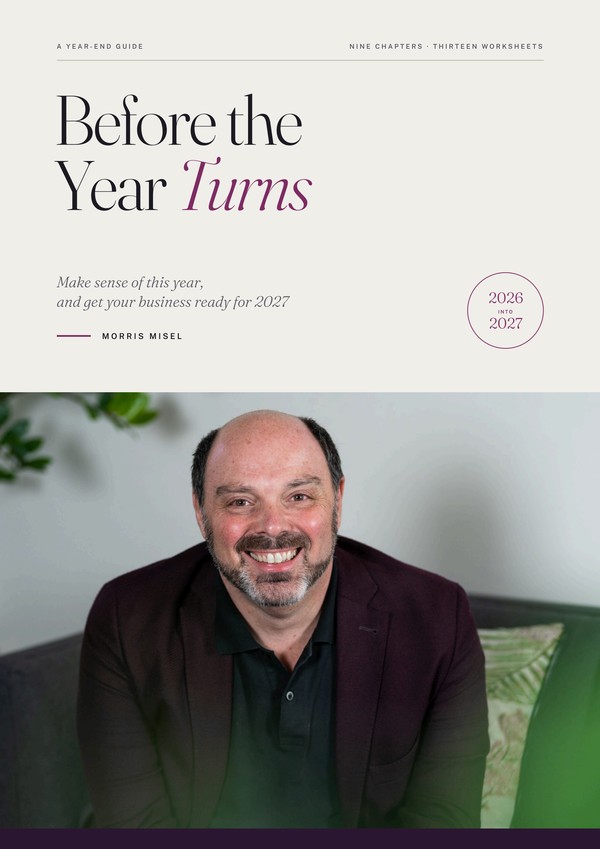
Before the Year Turns is out today, A$39 for 101 pages, nine chapters and thirteen worksheets, and every worksheet links to Leah’s finished one at the back, so you’re never staring at a blank page.
At the back I’ve written up the ripples I’m telling my clients and audiences to watch for in 2027, like why AI is going the way of social media, and why online didn’t kill the shops, it killed having to go, with links to the articles behind them.
There’s a fillable copy to type into as well, and it’s yours the moment you order. Here’s a 90-second look inside.
Everything’s on the guide page, with the free sample: morrismisel.com/guide
And if a big decision comes up while you’re working through it, you can talk it through with Mo, my AI double, in Choose Forward, and you can try him free at morrismisel.com/forward
Choose forward.
If you’d like a short read every Tuesday on what’s coming and what it means for your work: welcome.morrismisel.com/join
My year-end guide is at morrismisel.com/guide, and Choose Forward is at morrismisel.com/forward.
Morris Misel is a foresight strategist, keynote speaker, and trusted adviser. He works with organisations to interpret what’s changing and make better decisions about what comes next. Heard by more than a million people a year on stage and in the media.
Questions people ask
What is a ripple effect?
A ripple is what a change might set off for you and your business. The first ripple is what might happen directly, the second is what that might set off, and the third is what might open up or come under threat.
Is a ripple the same as second-order thinking?
It’s the same idea in plainer words. The second ripple is the second-order effect, the consequence of the consequence, and the third ripple is the third-order effect.
Why do the second and third ripples matter most?
They tend to arrive later and more quietly, and they often feel unrelated to the change that started them. By the time they’re obvious, a lot of the decisions about them have usually been made, and they can cost a lot more.
Is following ripples the same as predicting the future?
No, you’re working out what might follow from what’s already happening, early enough to get ready, and you expect it to keep moving. Knowing where you’re heading, your inhabitable future, is what lets you change course without losing your way.
How long does the ripples exercise take?
About 20 minutes, for one change from 2026 or one decision you’re facing in 2027. In Before the Year Turns it’s Worksheet 6A, and it’s free in the sample, on page 5.
What if I can’t see the second ripple?
Ask who’d be most upset by the first ripple and what they might do about it, because that’s often your second ripple.
Sources
Morris Misel, Ripple Effects: The Framework for Tracing What Comes After the Obvious, morrisfuturist.com, 1 July 2026.
Morris Misel, workshop for a business group in Brisbane, 24 June 2026 (recording in his archive).
AI Business Flywheel podcast with Joe Bonington and Duncan Isaksen-Loxton, recorded 8 October 2026, not yet released.
Hilton Barbour podcast on scenario planning, recorded 14 October 2026, not yet released.
Morris Misel, Before the Year Turns, chapter 6 “What it sets off” and Worksheet 6A, released 19 October 2026.