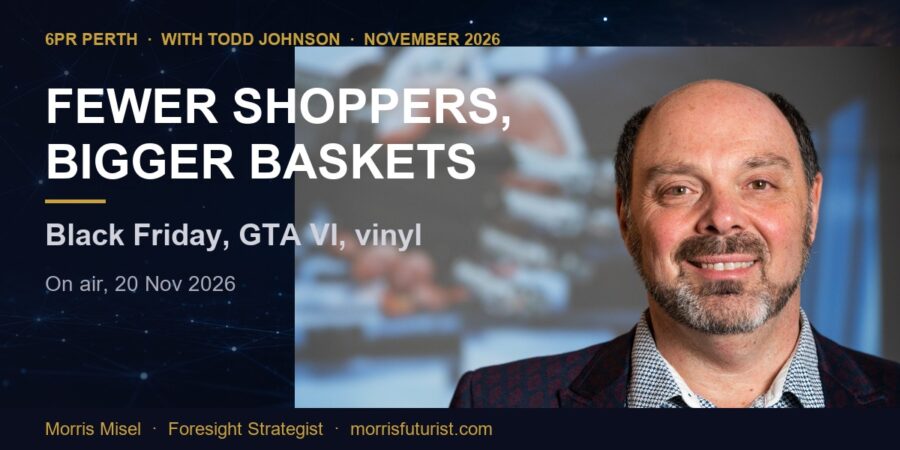
Black Friday 2026: Fewer Shoppers, Bigger Baskets, and My Chat With Todd Johnson on 6PR
Todd Johnson and I have been chatting on 6PR in Perth since October 2006, and on Friday 20 November he asked me to look into the crystal ball for 2027 with him, and Black Friday 2026 was high on his list.
We talked about Mo, the digital version of me, and then Black Friday, David Jones, vinyl records, Grand Theft Auto VI, and the handful of very big companies that now shape a lot of how we live.
You can listen to our full chat below.
Key points
- Black Friday 2026 in Australia is forecast to be a record A$7.2 billion, from fewer shoppers each planning to spend more.
- The divide between people with money to spend and people doing it tough is getting bigger, and you can see it in which shops are closing.
- David Jones wasn’t a great surprise. The question was always when, never if.
- By next year’s Black Friday, I think the queue could be our own AI, our digital twin, knowing what we’ve been wanting and moving the second the price drops.
- Vinyl, CDs, cassettes and old toys are selling, mostly to people buying back their memories.
- GTA VI took US$3.79 billion in retail sales on its first day, by Take-Two’s own estimate, and there’s a whole economy growing around games.
- A few very large companies now get to shape a lot of how we live, a bit like the East India Company once did.
- Mo, the digital version of me, lives at Choose Forward, and you can bring him a question free.
Black Friday 2026: fewer shoppers, bigger baskets
This year’s Black Friday sales run from Friday 27 to Monday 30 November, and the Australian Retail Council and Roy Morgan are forecasting a record A$7.2 billion, up 5.5% on last year.
Fewer of us will be doing the spending, though. Their survey has about 5.8 million of us planning to shop, down from about 6 million last year, and each of those shoppers planning to spend around A$920, about 14% more than last time.
So we’ve got more money coming from fewer people. Todd asked whether that means the rich are getting richer, and I think the divide is getting bigger, whichever way you want to phrase it.
The doom and gloom of nobody shopping doesn’t add up, because the cash registers are ringing. Retailers will take more overall, but they’ve also got bigger overheads, so more sales won’t necessarily mean more profit.
The people doing it tough are doing it tougher.
If you look at some of the brands that haven’t done well lately, they’re often the shops where people who are struggling a bit with their income just aren’t going as often as they once did, and for some of those shops the tough decision is that they’ve simply got to close.
David Jones wasn’t a great surprise
David Jones, the department store chain, unfortunately wasn’t a great surprise to me. The timing was always the question, never whether it would happen.
The receivers were appointed on 5 November, after the voluntary administrators, and the ABC has since reported that 19 stores will close, with 1,689 jobs slated to go.
I’d heard it coming from the supplier side, too. At a workshop in Brisbane, months before the administrators came in, one of the participants, who stocked David Jones, said he hadn’t been paid by them for six months.
He wasn’t sure about the future of David Jones, or about his own future as a stockist in it, and he was already working out what his next steps with them would be. That’s often how these things reach me, from the people living them, long before they make the news.
Earlier this month I wrote about the robot shoppers knocking on retailers’ doors, and David Jones was in that piece too. For decades they knew retail better than anybody on the planet for who they were, but online spooked them and they never really came to terms with it.
Todd brought up Civic Video and Blockbuster, which were all the rage until technology changed and the business model had to change with it. He’s still got a few VHS tapes at home, and he’s working out what to do with them.
We’re shopping extraordinarily differently, and I’d say that by this time next year it will be different again. What some people are already taking advantage of will be quite ordinary by then.
Next Black Friday, the queue could be bots
Within about 12 months, I think AI buying will be quite ordinary.
Amazon and others already remember what you’ve been looking at and bring it back to you, to get you to buy it now, and this is the reverse of that.
Your own AI, which knows you so well, understands what you’ve been looking for, even if you didn’t realise it yourself, spots something you might want, and works out where and when to buy it and at what price, then lets you know or buys it for you.
That’s your digital twin working on your behalf, with a list of the things you’ve been wanting, and the moment the price falls, it moves.
Remember the queues outside Myer and David Jones for the Boxing Day sales? By next year’s Black Friday the queue could be bots, lined up a bit like automatic share trading, each one waiting for its price.
And my guess is that if thousands of us tell our AI to buy the same television the moment it hits $199, they’ll all go at the very same second it does, and the special could be gone before any person has even seen it.
Some of the pieces are already here. Amazon says its Alexa shopping agent in the US can buy things for you when the price is right, and in a Salesforce survey on 19 November 8% of shoppers said an AI agent had already made purchases for them, although 73% still aren’t ready to hand over their credit card details.
Software getting to the front of the line isn’t new, either, because when Walmart put the PlayStation 5 on sale in November 2020, it blocked more than 20 million bot attempts in the first 30 minutes alone. Walmart called them Grinch bots, and it shows how fast software can move when a price drops.
And the shops are already deciding whether to let AI shoppers in at all.
Buying back the memories
Todd’s next question was music, because vinyl and CDs are coming back into fashion, and I’d add cassette tapes to that. All three of them are coming back, and it’s part of a nostalgia we’ve gone deep into over the past few years.
It’s not everybody. It tends to be the people who grew up with them, and it’s predominantly baby boomers, people now around their 60s who are a little bit cashed up, trying to buy back the memories.
Vinyl takes us back to some wonderful period in our past, the music on it and the way it sounded. ARIA’s wholesale figures for 2025 show vinyl album revenue in Australia up 4.1% to A$46.3 million, and CD revenue up 29.6% to A$21 million, its strongest year since 2021.
It’s not just music, either. If you look at nostalgic toys going back to the 60s, and especially the 70s, they’re selling well above what they should be selling for.
Nostalgia was one of my 13 trends for 2013, the year vinyl sales were up 70% and Belinda King and I took a nostalgic look at the future on ABC Tasmania.
By 2024 I was writing that baby boomers are buying back their memories, while their grandkids think the old toys are brand new.
That same year I wrote about the nostalgia economy becoming big business.
A listener, Peter, texted in to say he might sell his tape collection, a lot of Supertramp and some Queen at Wembley, which Todd thought could be worth a fortune these days.
GTA VI and the economy around the game
Grand Theft Auto VI came out on 19 November, the day before we spoke, and it’s the first new GTA in 13 years.
Put it next to the last one and the cinematic value alone is quite incredible. It’s like watching a movie, and the technology behind how these games are made has changed, because they’re getting richer and deeper and more immersive.
The people who make them take the future seriously, too. In 2014 Activision brought me in to do a research project and a round of media interviews on the future of war technology for Call of Duty: Advanced Warfare, which is how I ended up talking invisibility cloaks, smart guns and exoskeletons with IGN.
Todd had heard about a billion dollars in sales in the first 24 hours. The official figure came out after we spoke: Take-Two, which owns Rockstar Games, says day-one retail sales reached US$3.79 billion, with 32.5 million copies sold before it was even released.
Usage is definitely up. Todd wondered whether people gaming means people not shopping, and I’m not sure it does, because a lot of the games are expensive and many of them let you buy things inside the game.
A lot of games are also being used now to market products and services. You might see a brand you know pop up on a billboard as you walk through the game, so you’re not buying it there and then, but it’s feeding the marketing message.
Then there are the peripherals that go with it, the shoes and the tops people are wearing, and the places they go, so there’s definitely an economy coming out of it.
In February 2025 I wrote about AI that doesn’t just play games but builds them. So if your customers are spending their evenings in these games now, does your brand belong there too?
Companies we didn’t vote for
Todd finished on money. A lot of it is going into a few places, like the chipmaker Nvidia and Anthropic, the company behind the AI assistant Claude, and a lot of us are quietly sitting back thinking we can’t even imagine that kind of wealth, so is that divide going to get worse?
I don’t know what normal is any more. We’ve always had the extremely rich, a couple of well-known names like the Rockefellers, but back then it was newspapers, radio and television, so we heard about a few of them.
Now we’ve got social media and a constant feed of information, so we hear a lot more names, and I’m not sure that by volume there are any more of them.
They certainly have a great impact on the world, and that same morning, 20 November, I’d written about Anthropic floating on the Nasdaq, and how it took me straight back to the East India Company.
It was the English company chartered at the very end of 1600, and it went to India, started trading spices, made a lot of money, and eventually had its own army.
My concern with all of these companies is that they’re so large now, so pervasive and invasive, with so much money behind them, that they get to dictate a lot of how the world might be. These are corporations we didn’t vote for, run by people we don’t know.
Every time we use a piece of AI, we’re going down a rabbit hole they created for us. Every time we watch media they’ve put out, we’re watching, and I use the word loosely, propaganda. I don’t mean it in the sense of being bad, but we’re watching what they wanted to fund and wanted us to see.
So my concern is that we might be getting a bit narrow in the influences we see, because a lot of that wealth is spread across so many different parts of business.
In 2021 I said the companies heading into space were the equivalent of the Dutch East India Company.
As I said in that post, I use these AI tools most days myself, and I’d like us to be the ones who choose which bits of our working life we do their way, and which bits we keep as our own.
Meet Mo
Todd also asked about my online project. Like most people this year, I’ve been trying to figure out what we do with AI, and one of the things I did was recreating me in digital format, as if one wasn’t enough, and I called him Mo. What else would I call him?
Mo is a futurist online who will walk you through, and mostly talk you through, the stuff I do day in and day out. He’s drawn on more than 30 years of my work, and Todd’s in there too, because he and I go back almost 20 of those years. It’s been an extraordinary journey putting him together.
You’ll find him at Choose Forward, where you can bring Mo your question on the front page, free, with no sign-up.
Before the sales start
If you sell anything, before Black Friday on 27 November it’s worth putting this year’s customer list next to last year’s and seeing who hasn’t been back. They’re often the people doing it tough, who just aren’t turning up as often as they once did, and they won’t show up anywhere in the Black Friday totals.
And if you’re shopping, have a look at which of the things in your basket are a memory you’re buying back, and which you’d buy on any other day.
Who’s missing from your list this year, and what would bring them back?
Choose forward.
If you’d like a short read every Tuesday on what’s coming and what it means for your work: morrismisel.com/join
My 2027 series starts on YouTube on Monday 23 November, one short chapter a day. It looks back at what 2026 set off and forward to the ripples already heading our way in 2027, from money and work to customers, AI and trust: youtube.com/@morrismisel.
And if you’d like to work through the year-end questions at your own pace, my guide, Before the Year Turns, is at morrismisel.com/guide.
This post is based on my segment with Todd Johnson on 6PR Perth, 20 November 2026.
Questions people ask
How much will Australians spend on Black Friday 2026?
The Australian Retail Council and Roy Morgan forecast a record A$7.2 billion over Black Friday and Cyber Monday, Friday 27 to Monday 30 November 2026, up 5.5% on 2025. They expect about 5.8 million shoppers, down from about 6 million, each planning to spend around A$920, about 14% more.
Why are fewer people spending more this Black Friday?
Morris Misel’s read on 6PR: the divide is getting bigger. People with money to spend are spending more, while people doing it tough are going to some shops less often, and some of those shops are closing.
Why are vinyl records, CDs and cassettes coming back?
Nostalgia. Morris Misel says it’s mostly people who grew up with them, predominantly baby boomers who are a little bit cashed up, buying back the memories. ARIA’s 2025 wholesale figures show Australian vinyl revenue up 4.1% and CD revenue up 29.6%.
How much did GTA VI make on its first day?
Take-Two says Grand Theft Auto VI’s day-one retail sales reached US$3.79 billion, based on company estimates through the end of 19 November 2026, with 32.5 million copies sold before release.
Will AI shop for us on Black Friday?
Morris Misel’s forecast is that within about 12 months AI buying will be ordinary: your own AI, your digital twin, knowing what you’ve been wanting and where and when to buy it, alerting you or buying the moment the price falls, so next year’s Black Friday queue could be bots. Pieces are already here: Amazon’s Alexa shopping agent can buy when the price is right, and in Salesforce’s November 2026 survey 8% of shoppers said an AI agent had bought for them, while 73% weren’t ready to hand over card details.
Who is Mo?
Mo is the digital version of Morris Misel, a futurist you can talk to online, drawn on more than 30 years of his work. You can bring Mo a question free on the front page of Choose Forward at chooseforward.today.
Sources
- Morris Misel with Todd Johnson, 6PR Perth, 20 November 2026 (segment audio above).
- Australian Retail Council and Roy Morgan, Black Friday and Cyber Monday spending forecasts 2026, 11 November 2026.
- ABC News, David Jones store closures and jobs to go, 18 November 2026.
- Retail World, Voluntary administrators appointed for David Jones, 6 November 2026.
- ARIA, Recorded music grows in 2025, 19 March 2026.
- Take-Two Interactive, Grand Theft Auto VI day one retail sales, 20 November 2026.
- Salesforce, Cyber Week AI sales forecast 2026, 19 November 2026.
- Amazon, Alexa for Shopping, opened 21 November 2026.
- Walmart, Doing our part to ensure customers, not Grinch bots, can buy this season’s hottest items, 15 December 2020.
- HISTORY, Charter granted to the East India Company, opened 21 November 2026.
- Morris Misel, Anthropic and the East India Company, LinkedIn, 20 November 2026.
- Morris Misel, Robot Shoppers Are Knocking, and the Shops Are Deciding Whether to Answer, 4 November 2026.
- Morris Misel, Everything old is futuristic again, 2 October 2013.
- Morris Misel, Where do space babies come from?, 15 June 2021.