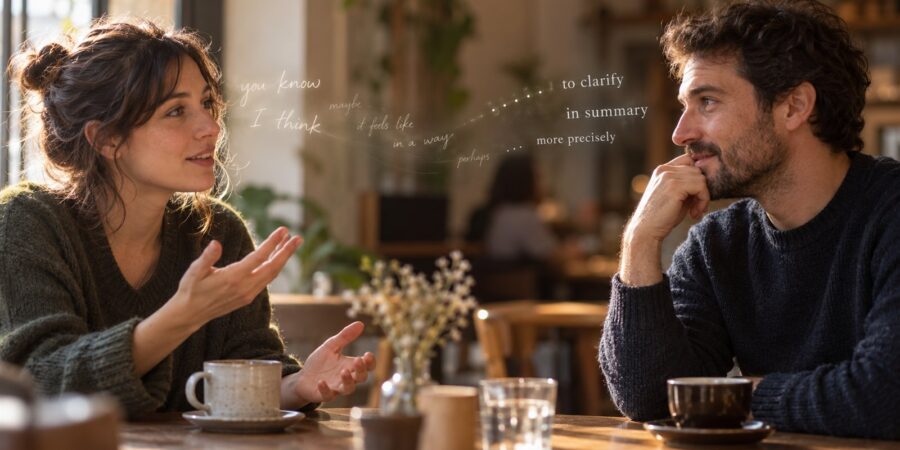
We Talk Like Whoever We Spend Time With. Now That Includes Chatbots.
Key points
- People are picking up phrases from AI chatbots at work and at home, and some call it “Claude speak”.
- Researchers at the Max Planck Institute for Human Development found that words chatbots favour turned up more often in people’s spoken talks after ChatGPT arrived.
- We’ve always borrowed words from whatever surrounds us, from Shakespeare’s crowds to text messages, and the words we pick up shape how we think, decide and relate to each other.
- The question for the next few years is whose words we’d like to be thinking in.
On RTHK Radio 3 in Hong Kong this week, Phil Whelan turned the page on our Nobel Prize chat with a story from the Wall Street Journal about people who’ve started talking like the chatbots they spend their day with.
Some people have a name for it: Claude speak, after one of the better-known chatbots.
Phil had his own version of it, too. He’d been sorting out a fiddly sound problem with Grok, another chatbot, and later started telling his mates about “that thing I was talking about”, until he realised he’d never talked to them about it at all, because the only one he’d talked it through with was Grok.
You can hear the three minutes here.
A note on the numbers you’ll hear: the Max Planck team counted single words in about 280,000 YouTube talks, and the stock phrases come from the Wall Street Journal story, which is where the two sit side by side below.
What people mean by talking like chatbots
The Wall Street Journal story is by Katherine Bindley. It’s full of people who’ve caught themselves at it in meetings, group chats and emails.
A woman who invests in new companies in Stockholm heard herself tell her team that their morning meeting was “a reset”.
A recruiter in California noticed his work messages had picked up a stiff, samey sound that didn’t feel like him.
Others in the story point to phrases like “load-bearing”, “smoking gun” and “X is the new Y”. There are lines that tell you what something isn’t before they tell you what it is. And there’s a lot of telling workmates their idea is “brilliant”.
One small company in San Francisco keeps a tally board, with a mark for each chatbot phrase someone uses, and whoever has the most marks at the end of the week buys the drinks.
What the Max Planck study found
The research comes from the Max Planck Institute for Human Development in Berlin.
The first version came out in 2024. The team looked at about 280,000 YouTube videos in English, from more than 20,000 channels run by universities and other places of learning.
They picked out words that ChatGPT likes to use, such as meticulous and boast. Then they counted how often people said those words in their talks, and the words turned up more often after ChatGPT came out in late 2022.
A later version added hundreds of thousands of podcast episodes. The team chose ones where people were talking freely, so it wasn’t just people reading from a script.
Then they ran a test with nearly 500 people, and a short chat with a chatbot was enough for people to start using its words as their own, even after they’d moved on to something else.
We’ve always borrowed words
None of this is new in shape.
We’ve always talked like whoever, and whatever, we spend the most time with.
Shakespeare’s English was everyday, even low, English in his own time, the language of the crowd standing in front of the stage, and four hundred years later we teach it as high culture. I wrote about that in 2024, in Language Evolution: From Shakespeare to Sigma.
Phil and I have covered this before. On 1 March 2016, on RTHK Radio 3, we talked about what I called a digital cultural revolution. Billions of people were coming online from almost every country, speaking thousands of languages and meeting in one space with no borders. In my post that day I asked, “Which language is used more often? Whose values are upheld?” It’s still on the blog, in Viva La Digital Cultural Revolution.
Later that month I gave a keynote on digital multiculturalism, and I wrote a piece on the same ideas. For most of history, the place you grew up in gave you your language, your values and your sense of right and wrong. Online, we’d started moving in and out of many cultures every day, which left us to ponder “whose cultural values will we follow?” You can hear me talk it through on ABC radio in The Future of Australia’s Culture.
In June the Oxford English Dictionary added “yeah nah”, our very Australian way of saying no while keeping everyone friends. I wrote about it in Yeah Nah, We’ve Always Known This, because a dictionary follows a culture, and the words that make it in are the ones that stuck.
That same month, scientists found the stretches of DNA linked to language in Neanderthals too, which suggests language is older than our own species.
So the habit is ancient.
What we borrow says a lot about where we’ve been spending our time.
The words we pick up shape how we think
On air I put it this way: “we use culture and language to define what’s important to us at the moment and we kind of mimic everybody else.”
Every phrase we borrow arrives with a way of seeing. “Load-bearing” brings an engineer’s eye with it, so you start looking for the one part that holds up the rest. A contrast line turns every choice into a swap, one thing out and another in, and it can make a decision sound settled before anyone has argued it through.
Praise works the same way. If everyone in a room calls every idea brilliant, the word stops meaning much, and people quietly look for other ways to tell whether their work was any good.
I said much the same on RTHK Radio 3 last October, that AI “tells us we’re so wonderful and terrific and right”, in Have We Outsourced Thinking to AI?.
I said on air that younger people already “use Twitter terms, they use SMS language”, and that these are “shorthand ways that that particular piece of software has trained us to think or speak or interact with people.”
Phil’s Grok story points to something else again. When we lose track of who we talked a problem through with, a person or a tool, it could quietly change who we credit, who we trust and who we go back to next time.
In 2017 I wrote that we’d soon talk to the devices around us and “never be quite sure what we are talking to”. That’s in The future of communication.
I’ve been watching this for a while, and a week later, in Are you mad talking to a chatbot, I told Barry Nichols on ABC Radio Perth that chatbots pointed to a world where technology would talk back to us “using a human persona”.
What might be different this time
For most of history, new words bubbled up from many places at once: the schoolyard, the footy, the stage, the street stall, the kitchen of a family who’d just arrived from somewhere else. That mix is why “dim sim” and “yeah nah” sound like Australia and nowhere else.
This time a big share of new phrasing could come from a small number of tools that a lot of us use at the same time, all built to sound calm, polished and agreeable.
In 2016 I wrote that, for centuries, one dominant power had set the shared culture, from Rome to the British Empire to American media since the 1950s, and that the internet was breaking that up. A few popular chatbots could pull some of it back together.
The Max Planck researchers raise the chance that this could narrow the range of how we speak.
If it does, the ripples might show up well beyond words. Proposals could start to read the same. Job applications might all sound alike, so the people reading them look for other signs of who someone really is. And the odd, curious, slightly wrong word, the one only you would use, might become the most human thing on the page.
We can keep using these tools and still notice what we’re picking up from them, the same way we’d notice a new saying the kids brought home from school.
Questions people ask
What is Claude speak?
People are calling it Claude speak: phrases picked up from AI chatbots, like contrast lines, “load-bearing” and calling every idea brilliant. The Wall Street Journal wrote it up in October 2026.
Are people really starting to talk like chatbots?
Researchers at the Max Planck Institute for Human Development found that words chatbots favour, such as meticulous and boast, were used more often in YouTube talks and podcasts after ChatGPT was released. In a separate test, people started using a chatbot’s words as their own after a short chat with it.
Does the language we use change how we think?
It might. The words we borrow carry a way of seeing, so they can shape what we notice, how we frame a choice and how we relate to the people around us.
A question to take with you
Language has always moved with whoever we spend the most time with, and for a lot of us that now includes a tool we talk to several times a day.
So, five years from now, when you read back the emails, proposals and speeches you wrote this year, whose voice do you think you’ll hear?
Sources
- The Wall Street Journal, Katherine Bindley, October 2026: Now We’re All Starting to Talk Like AI Chatbots Too.
- Yakura et al., Max Planck Institute for Human Development, first version September 2024, revised July 2026: Empirical evidence of Large Language Model’s influence on human spoken communication.
- Scientific American, Vanessa Bates Ramirez, 11 July 2025: ChatGPT Is Changing Our Spoken Language.
Choose forward.
If you’d like a short read every Tuesday on what’s coming and what it means for your work: welcome.morrismisel.com/join