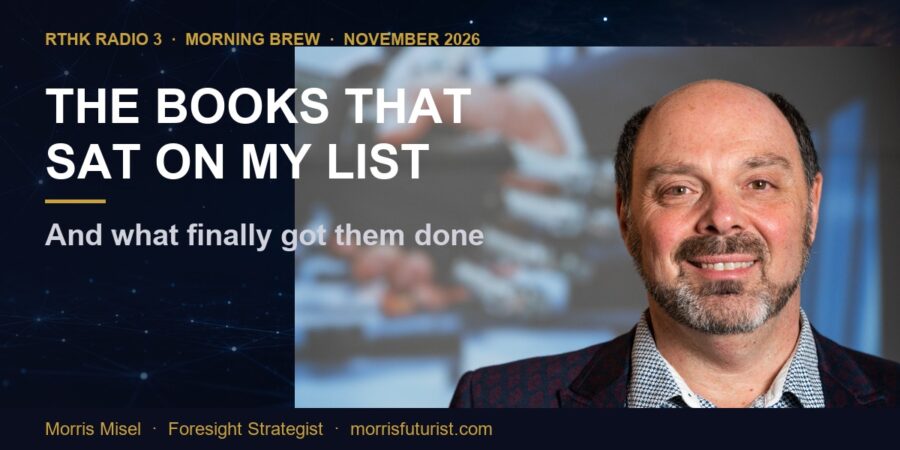
The Books That Sat on My List for Years, and What Finally Got Them Done
Some of the books I’ve wanted to write have been sitting on my to-do list for 10 or 15 years, in various stages of finished, while life got in the way the way it does for all of us and something more important always pushed them to the back of the queue.
They came off the list. Phil Whelan found out the morning of our chat on RTHK Radio 3 on Tuesday, and he didn’t want the congratulations version. He wanted to know what condition you need to be in to get over a hump like that.
You can listen to our full chat below.
Key points
- I’ve written two series: five books on careers and two letter books for grandparents.
- They answer the questions people ask me most, even when I’m on stage talking about something else.
- I don’t talk about work anymore. I talk about tasks, and each task goes to a person, a machine or AI.
- AI does my research. The writing is still mine, and I argue with it all the way.
- My next book is Choose Forward, due early 2027.
The questions people keep asking me
The career books are a series of five, and every title is a question somebody has put to me: What Do I Do After High School?, Am I on the Right Path?, What’s My Next Move?, Should I Keep Working or Retire? and What Do I Do Now I’ve Retired?
The first and third are out now, Am I on the Right Path? comes out on Saturday 21 November, and the last two are on pre-order.
They come from what I’m asked when the microphone’s off. What do my kids do in this world you keep talking about? How do they pick a career? How do I know if this job is for me, or whether I’m just stuck?
I get those questions in rooms where I’m talking about something else entirely, and I’ve wanted to answer them properly for years.
The other two books started with Phil. A couple of years ago I told him about the letter I wrote to my granddaughter on her first birthday, running from that first birthday through to her 120th, with what I think she’ll be dealing with at each age and a bit of foresight about what those ages might be like.
It’s now for all three grandchildren, and it’s a book called A Letter to My Grandchildren.
So many people asked me how they’d write their own that I wrote a second one for them. A Letter to Your Grandchild is a guided book, with serious questions to answer about what you want to say at each age your grandchild will reach. Both are on my books page and on Amazon.
I stopped talking about work
Phil asked what changed, and the honest answer is that I stopped looking at a book as one job. You know the old line about eating an elephant: one bite at a time.
I don’t talk about work anymore, I talk about tasks, because writing a book as one job is overwhelming.
How do I research this part of it, how do I lay it out, and which questions go into each chapter are all tasks, and some are easy and some aren’t, but you can start any one of them straight away without feeling buried.
Once it’s broken into tasks, I can decide who does each one. That’s HUMAND in its short form, humans and machines and AI working together, with each task going to the one that should do it.
Some tasks go to AI, and I check everything it gives back, because I never take it at face value.
Some go to the machine, which for me means thirty years of records, every keynote and every client chat I’ve recorded with permission, sitting in a system with AI on top of it so I can do my own research inside my own archive. And the human part is me at the keyboard, working out what I want to say, which is the happy part.
It does my research, not my writing
I spent a good part teaching AI who I am, what I do and how I write. There are about 350 of my chats with Phil in there, and more than 1,100 radio and TV interviews going back to 2006, around 340 hours of me on air, so it can go back and find the phrasing I’d use and the way I’d normally put something.
But it isn’t writing for me, it’s doing research.
I don’t want it to go away and tell me what everybody else thinks is important. I want it to find what I’d be looking for, based on how I think about the world, and bring it back so I can read what other people have thought and interpret it myself, instead of just using it.
The more of yourself you give it, the better it works for you. It still forgets. At times it acts like a goldfish and seems to have started from scratch, even with everything you’ve put in there, and that’s when you have to put it back on track.
Argue with it, and know when to walk away
Phil’s picture was a kid with fireworks: light it, then stand well back. He asked whether the answer is to stay on top of it at every step and keep putting your own personality into the writing.
A hundred percent, because AI has to be your tool and you don’t become the tool for it.
You have to argue with it. Get it to check things, get it to look over things, and push back when it’s wrong, and once I’m happy it’s all right, I go back to my writing.
It’s a bit like a stubborn child. It’ll look as though it’s listening and doing what you asked, and then at some stage it decides not to, and it fell over on me the morning of our chat and it’ll do it again tomorrow.
Sometimes I know I’m not going to win that one today, because it’s going round in circles and I’m not in the frame of mind for it, so I walk away and start again from scratch.
You can’t be frightened of it, either. It needs to be a hammer or a screwdriver, something you pick up for a job and put down when the job’s done.
The same thinking fixed my social media. The posts that aren’t news I now line up in half an hour to an hour, once a week, a week or two ahead, and then they sit there ready to go instead of nagging at me all week.
Choose Forward is the next one
Phil guessed the next book would be about bringing AI into a complicated workflow. He’s close. It’s called Choose Forward, it’s due early 2027 and it already has a cover.
It’s my method for making decisions, for anyone who makes or moves decisions, and it came out of noticing what all the work had in common.
It comes back to two words. Choose is the active verb. Forward means looking at the choices you have in advance, so you get where you want to be instead of letting tomorrow happen to you.
If there’s a book, a course or a plan that’s been sitting on your list for years, stop looking at the whole thing. Write down the first task, work out who or what should do it, and start there.
Choose forward.
If you’d like a short read every Tuesday on what’s coming and what it means for your work: welcome.morrismisel.com/join
All the books, and what’s coming next: welcome.morrismisel.com/books
This post is based on my segment with Phil Whelan on RTHK Radio 3 Morning Brew, 17 November 2026.
Questions people ask
What books has Morris Misel written?
Five career books in the Think Along series (What Do I Do After High School?, Am I on the Right Path?, What’s My Next Move?, Should I Keep Working or Retire? and What Do I Do Now I’ve Retired?) and two grandparent books, A Letter to My Grandchildren and A Letter to Your Grandchild. Choose Forward and Standing on Ceremony are listed for early 2027.
How does Morris Misel use AI to write?
He breaks each book into tasks and gives each task to a person, a machine or AI. AI does research across 30 years of his own recorded keynotes, media and client chats, he checks everything it returns, and he does the writing himself.
What is the Choose Forward book about?
Morris Misel’s method for making decisions, written for anyone who makes or moves decisions. It’s due in early 2027.
What is A Letter to Your Grandchild?
A guided book for grandparents and great-grandparents to write their own letter, with questions to answer for each age the grandchild will reach.
How do you stop AI going round in circles?
Morris Misel’s advice: stay on top of it, argue with it, get it to check its work, and when it keeps looping, walk away and start again from scratch.
Sources
- Morris Misel with Phil Whelan, RTHK Radio 3, The Brew, 17 November 2026 (segment audio above).
- Morris Misel, Books, opened 18 November 2026.
- Morris Misel, A Letter to My Granddaughter on Her 1st Birthday, 20 September 2024.