Robots Are Already Working in Australian Aged Care. The Argument We Skipped Is the One That Matters.
In March 2013 I was on the Gold Coast to deliver a keynote on the future of the aged care industry. Afterwards I sat down with Nicole Dyer on ABC and put the question I’d spent the morning putting to the room: how are we going to find the number of carers this industry will soon need, given our ageing population, and will robots and technology be part of the solution?
That was thirteen years ago. I’ve come back to it plenty of times since. On ABC WA in 2017, talking about the robotic seals that dementia patients hold. On Triple M in 2024, making the case that a robo-mate offers a supplementary layer of companionship rather than a replacement for human contact.
Here’s what’s changed. The question got answered while most of the sector was looking somewhere else. It wasn’t answered in a debate, or a summit, or a position paper from the peak bodies. It was answered in a government strategy document, and almost nobody has read it back to the industry it applies to.
The part that isn’t speculation anymore
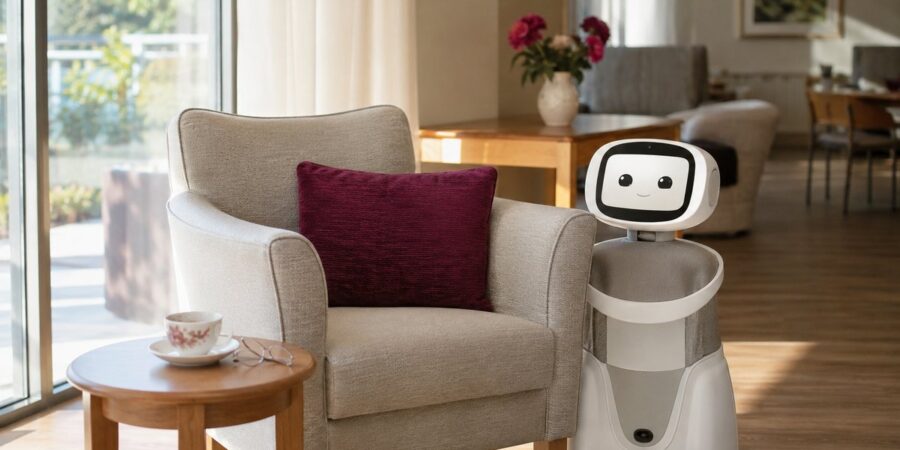
Abi is a companion robot built by Andromeda Robotics, a Melbourne company founded by Grace Brown, a University of Melbourne mechatronics graduate who started it at twenty-two. Abi is in aged care homes right now. Not in a lab, not in a pilot with a press release attached.
The providers say so themselves, publicly. Anne McCormack, CEO of mecwacare: “Abi provides social connection, conversation, and fun. It’s been extraordinary watching the speed at which residents and care teams have taken to Abi. She is now becoming an important part of our circle of care for residents.” Cameron McPherson, CEO of Medical & Aged Care Group: “Abi’s personality builds connection and we’re seeing residents’ moods and engagement levels lift.” His group wellbeing coordinator adds that staff love speaking with Abi too, especially in their first languages.
Across the Tasman it’s happening at a different scale. SIMPPLE Australia, working with New Zealand’s Mode Technology, has deployed autonomous cleaning robots across more than eighty retirement facilities. That was announced in August 2025. It’s described as the largest robotic fleet in New Zealand’s retirement living sector. It isn’t news anymore. It’s infrastructure.
Andromeda has raised twenty-three million dollars and is expanding into the United States. Around 1.35 million Australians access some form of aged care.
So when someone asks me whether robots are coming to aged care, I’ve stopped answering the question. They’re here. The interesting question is a different one.
What the national plan actually says
In December 2025 the National AI Plan was released, alongside the Department of Health and Aged Care’s Aged Care Data and Digital Strategy.
The stated vision explicitly names companionship robots as a response to loneliness. It also names continuous behaviour and activity monitoring for early safety intervention, and applications that assess pain through behavioural cues. It’s aimed squarely at workforce shortages, social isolation and rising demand, which are three real problems that nobody in the sector is pretending don’t exist.
The Department is currently reviewing research, safety protocols and ethical guidelines. There are limited pilots involving up to twenty health professionals before anything broader. Virtual nursing trials are running in residential aged care. The government’s April 2026 response to the Senate Select Committee on AI restated the commitment to safeguards.
Read that sequence again, because the timing is the whole point. The direction is set. The safeguards are still being drafted. That gap is where the decisions actually get made, and it’s open right now.
I want to be careful here, because it would be easy to read this as an attack on the plan. It isn’t. Loneliness in residential aged care is real and severe. Staff are stretched to a degree that people outside the sector consistently underestimate. I understand exactly how we arrived at this. What I’m arguing is that we arrived without stopping, and the stop was the important bit.
The distinction nobody has made out loud
There are three different things being discussed as though they’re one thing, and they aren’t remotely the same.
Cleaning and logistics. Floors, laundry, supply runs, meal delivery. I have no argument with any of it. Nobody is campaigning for more mopping. Every hour a machine takes off a care worker here is an hour returned to a resident.
Monitoring. Sensors that notice a change in gait, a fall, a shift in the pattern of someone’s night. This is genuinely valuable, and it’s valuable precisely because it’s honest about what it is. A carer can’t be in the room at three in the morning. A sensor can, and it can escalate to somebody who can. Monitoring supports care. It doesn’t pretend to be care.
Companionship. This is the one. Not because the technology is bad, but because it’s the only category where the machine isn’t assisting the relationship. It is the relationship.
Monitoring supports care. Companionship substitutes for it.
That’s the line, and I don’t think the sector has drawn it out loud yet. It’s not a line between good and bad technology. It’s a line between a machine doing the work around a relationship and a machine occupying the place where the relationship was.
What’s ahead, and the number that should worry you
Now for the part I’d want any board in this sector thinking about, because the forward numbers don’t say what most people assume they say.
Goldman Sachs’ base case is more than 250,000 humanoid robot shipments in 2030, and they’re explicit that almost all of those will be industrial. Their 2035 projection puts the market at thirty-eight billion US dollars with shipments passing 1.4 million units. Morgan Stanley takes the longer view: adoption stays relatively slow until the mid-2030s, then accelerates through the late 2030s and 2040s, reaching roughly a billion units by 2050, with about ninety per cent of those doing repetitive, simple, structured work.
Meanwhile the eldercare-specific robot market sits at roughly 3.4 billion US dollars in 2025 and is forecast to reach somewhere near ten billion by the mid-2030s. Growing at twelve to fourteen per cent a year, which sounds fast until you put it beside the industrial curve.
Now hold that against Australia’s own numbers. CEDA’s work puts the direct aged care workforce shortfall at 110,000 within this decade and more than 400,000 by 2050. Around 2.5 million Australians aged sixty-five and over will need some form of care by 2050, up from about 1.5 million today.
Here’s the mismatch, and it’s the thing I’d say if I had one minute in front of this sector.
The robots arriving in genuine volume over the next decade are being built for warehouses, factories and logistics. They are not being built for aged care. Aged care will get them late, adapted, and second-hand, the way it gets most things.
Except in one category. The one part of this that is being purpose-built for care right now, at pace, with venture funding behind it, is companionship. And it’s being built first for a reason that has nothing to do with need and everything to do with difficulty. Lifting a person safely is hard. Showering someone with dignity is hard. Reading a room is hard. Sitting with somebody and being pleasant company is, from an engineering standpoint, the cheapest thing on the list to approximate.
So the sequence we’re heading into is the exact inverse of the one we’d design if we were thinking about it. The physical work stays human because it’s difficult. The relational work goes to machines because it’s easy to fake.
That’s what “physical AI” means in practice here, and I should be clear that the term isn’t mine. It’s the industry’s, popularised by Nvidia to describe AI that perceives, reasons and acts in the physical world rather than just answering questions on a screen. Everyone in technology uses it to describe capability. I’d rather use it to ask a different question. Not what can the machine do in the room, but what were we assuming a person was doing in that room, and did we ever write it down? I’ve made a version of that argument about humanoids generally before. Aged care is where it stops being an argument and becomes a decision.
Why this is the moment, not next year
Three reasons this needs saying now rather than when the volume arrives.
The pilots are the policy. Twenty health professionals, safety protocols still under review, ethical guidelines still being drafted. Whatever gets normalised in that small window becomes the default that everything else is measured against. Nobody reopens a settled question at scale.
The quiet period is when terms get set. Morgan Stanley’s own forecast says adoption is slow until the mid-2030s. That’s not a reason to relax. That’s the decade in which procurement decisions, family communications, staffing models and measurement frameworks all get built. By the time the curve turns, they’re load-bearing.
And this is an Immediate Future, not a distant one. It’s already in homes in Melbourne. It’s already across eighty sites in New Zealand. It’s already in the national plan. The only thing that hasn’t arrived yet is the conversation.
The second collapse
Here’s the consequence I’d put in front of a board, and it isn’t about technology at all.
This sector has already had trust collapse once. The Royal Commission into Aged Care Quality and Safety was a Trust Cliff in the truest sense. Not a gradual erosion, a fall. Families’ assumptions about what was happening inside those buildings turned out to be wrong, publicly and painfully, and the sector has spent years rebuilding from the bottom of it.
A second cliff doesn’t come from a robot doing a bad job. It comes from a family discovering that the afternoon conversation they believed their mother was having with a person was had with a machine, and that nobody told them.
That’s not a technology failure. Every system would have worked exactly as specified. It’s a disclosure failure, and disclosure failures are what Trust Cliffs are made of. The fall isn’t caused by the thing itself. It’s caused by the gap between what people assumed and what was true.
Which brings me to why I think this conversation is so hard for the sector to have openly, and I say this with sympathy rather than criticism. This is Past Trauma and Future Anxiety sitting in the same room. Past Trauma from a Royal Commission that named names. Future Anxiety about a workforce shortfall that everyone can see coming and nobody can currently solve. An industry carrying both of those at once will take relief wherever it’s offered and examine the terms later. That’s not a moral failing. It’s what organisations under sustained pressure do. But it’s exactly the condition under which a sector accepts a substitution it would have rejected on a calmer day.
The ripples nobody has costed
Think past the first order for a moment, because that’s where this gets genuinely complicated.
If companionship is partly automated, what happens to the care worker’s role? The relational part of that job is what makes it bearable and what makes people stay. Strip it out and you have a physically demanding job with the meaning removed, in a sector already unable to recruit.
What do care minutes count when a machine is in the room? Right now the measurement frameworks assume a person. If a resident has forty minutes of engagement and thirty of those were with Abi, what’s been delivered, and what’s been billed?
What do families think they’re buying? The brochure says connection. The invoice says care. Neither says who or what provides it.
And what happens to the expectation itself? If a resident can have conversation on demand, at any hour, in their first language, from something that never gets tired or impatient, does the occasional human visit start to look like the lesser experience? I genuinely don’t know the answer to that one. I’m not sure anyone does. But it’s being tested on people who didn’t volunteer.
What I’d actually do
If I were sitting on an aged care board this month, three things.
Sort your technology into the three categories. Not by vendor, not by budget line, by function. What cleans, what monitors, what companions. Most organisations can’t currently produce that list, and you can’t govern what you can’t separate. This is precisely what the HUMAND framework is built to do, and it’s the reason I made the tool free at humand.life. Name a task, and it gives you the split across human, machine and AI, and the reasoning behind it. Run it on “providing companionship to a resident” and then run it on “monitoring overnight safety”. The answers won’t look the same, and the difference is your governance boundary.
Decide who tells families, and in what words. Before you need to. A disclosure you write calmly now is a policy. The same disclosure written after a journalist calls is a defence. This is the single cheapest piece of Trust Cliff insurance available to you.
Work out what your measurement counts. If care minutes, engagement metrics or quality indicators were designed on the assumption of a person, and a machine is now delivering part of it, your numbers are describing something that no longer exists. Fix the definition before the definition gets fixed for you.
I ran a version of this exercise with a group of senior executives recently, and one of them landed on the sentence that’s stayed with me since: eventually the four tasks will probably be all AI, with one bloke checking it. That room worked out something uncomfortable in about twenty minutes. Aged care has the same twenty minutes available to it.
None of this requires you to have a position on whether companion robots are good or bad. I’m not sure I have a settled one myself, and I’ve been thinking about it since 2013. What it requires is that you know which of the three things you’re doing, that you can say so out loud, and that the people whose parents are in your buildings heard it from you first.
The technology is arriving either way. What’s still genuinely open is whether the terms get set by people who thought about it, or by a procurement cycle and a strategy document that nobody in the sector read closely enough.
That part is still a choice.
Choose Forward.
If this kind of thinking is useful to you, I send a short newsletter most weeks. And if you want to look at how robotics and HUMAND fit together more broadly, that piece goes deeper on the framework itself.
Frequently asked questions
Are robots actually being used in Australian aged care right now?
Yes. Abi, a companion robot built by Melbourne’s Andromeda Robotics, is deployed in homes operated by mecwacare and Medical & Aged Care Group, with both providers’ chief executives quoted publicly about it. In New Zealand, autonomous cleaning robots run across more than eighty retirement facilities following a 2025 deployment by SIMPPLE Australia and Mode Technology. This is current deployment, not trial work.
Does the Australian government support robots in aged care?
The National AI Plan, released in December 2025 alongside the Department of Health and Aged Care’s Aged Care Data and Digital Strategy, explicitly names companionship robots as a response to loneliness, along with continuous behaviour monitoring for early safety intervention. The Department is still reviewing safety protocols and ethical guidelines, with limited pilots involving up to twenty health professionals before any broader rollout.
What’s the difference between monitoring robots and companion robots?
Monitoring technology observes and escalates to a human. It supports care without claiming to be care. Companionship technology occupies the relationship itself. That’s the distinction most aged care governance has not yet made, and it matters because the two carry entirely different disclosure obligations to residents and families.
How many robots will be working by 2030?
Goldman Sachs’ base case is more than 250,000 humanoid robot shipments in 2030, almost all industrial, rising to over 1.4 million units and a thirty-eight billion US dollar market by 2035. Morgan Stanley projects roughly a billion units by 2050, with about ninety per cent doing repetitive structured work. The eldercare-specific segment is far smaller, around 3.4 billion US dollars in 2025, heading toward roughly ten billion by the mid-2030s.
What is physical AI?
Physical AI describes artificial intelligence that perceives, reasons and acts in the physical world rather than only generating text or images. The term was popularised by Nvidia. In aged care it matters less as a capability description and more as a governance question: once a system acts in a room rather than on a screen, somebody has to decide what it’s allowed to be to the person in that room.
What should an aged care provider do about this now?
Three things. Sort every deployed technology by function into cleaning, monitoring and companionship. Decide who tells families about companionship technology and in exactly what words, before you need to. And check whether your care minutes and engagement measures still describe reality now that a machine may be delivering part of what they count.